An ROC Certificate is the Certificate of Incorporation, the document the Registrar of Companies issues when your company or LLP is registered. It is the legal proof that your business exists as a separate entity under the Companies Act, 2013.
“ROC Certificate” is an informal name. No Indian law uses that phrase, and there is no separate form to apply for one, because you receive it automatically when your incorporation is approved.
If you already have a company and simply need a copy, you can download it free from the MCA portal in about five minutes. Jump to the download steps.
On this page
- What is an ROC Certificate?
- How to Download from the MCA Portal
- What Does It Contain?
- Why It Matters
- Who is Eligible?
- Documents Required
- How to Get It: SPICe+ Steps
- Does It Expire?
- Common Misconceptions
- FAQs
What is ROC Certificate?
An ROC Certificate, officially the Certificate of Incorporation, is the legal document issued by the Registrar of Companies at the time of company registration. It confirms that your company is registered under the Companies Act, 2013 and exists as a separate legal entity in the eyes of Indian law.
In simple terms, it is the birth certificate of a company.
The certificate arrives as a digitally signed PDF in the applicant’s registered email inbox once the MCA approves the incorporation. There is no physical application, no separate fee, and no renewal.
How to Download the ROC Certificate from the MCA Portal
When your company is incorporated, MCA emails the Certificate of Incorporation as a digitally signed PDF to the email address used in the SPICe+ filing. Check that inbox first.
If you no longer have it, you can get a copy from the MCA portal:
- Log in to your account on mca.gov.in
- Go to MCA Services > Document Related Services > View Public Documents
- Enter your company’s CIN or name
- Select the incorporation documents category and the year of incorporation
- Pay the small MCA fee online
- Open My Workspace > Documents and download the Certificate of Incorporation
Need a certified copy? For banks or legal use that needs a certified copy, use the Get Certified Copy service under Document Related Services and pay the MCA fee for it.
Note: The free “View Company/LLP Master Data” option shows company details like CIN, status and directors. It does not let you download the certificate itself.
What Does ROC Certificate Contain?
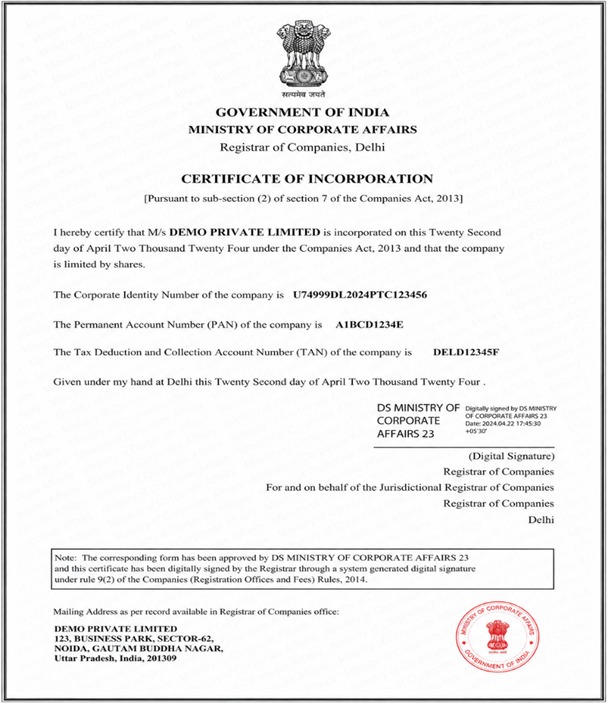
A Certificate of Incorporation contains the following key details:
| Field | Details |
|---|---|
| CIN (for companies) or LLPIN (for LLPs) | Unique identification number assigned at incorporation |
| Registered name | Full legal name of the company or LLP |
| Date of incorporation | The exact date the entity came into legal existence |
| Registered office address | Address on record with the ROC |
| Type of entity | Private limited, public limited, OPC, LLP, etc. |
| PAN | Permanent Account Number of the company |
| TAN | Tax Deduction and Collection Account Number |
| Digital signature | Signed by the Registrar of Companies only |
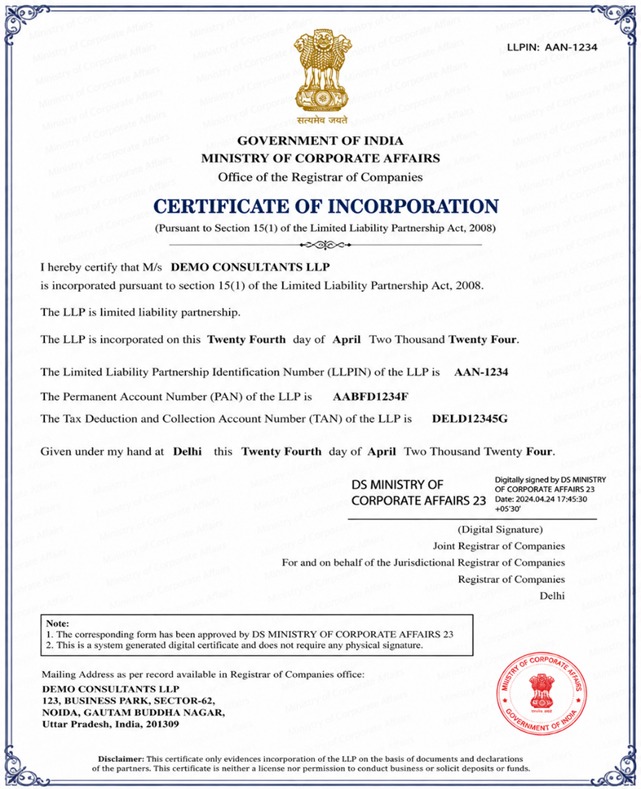
As the sample certificates below show, the document carries an official MCA seal and the digital signature of the ROC office. No physical signature from any director appears on the certificate.
Sample Certificate of Incorporation for a Company:
Sample Certificate of Incorporation for an LLP:
Why is ROC Certificate Important?
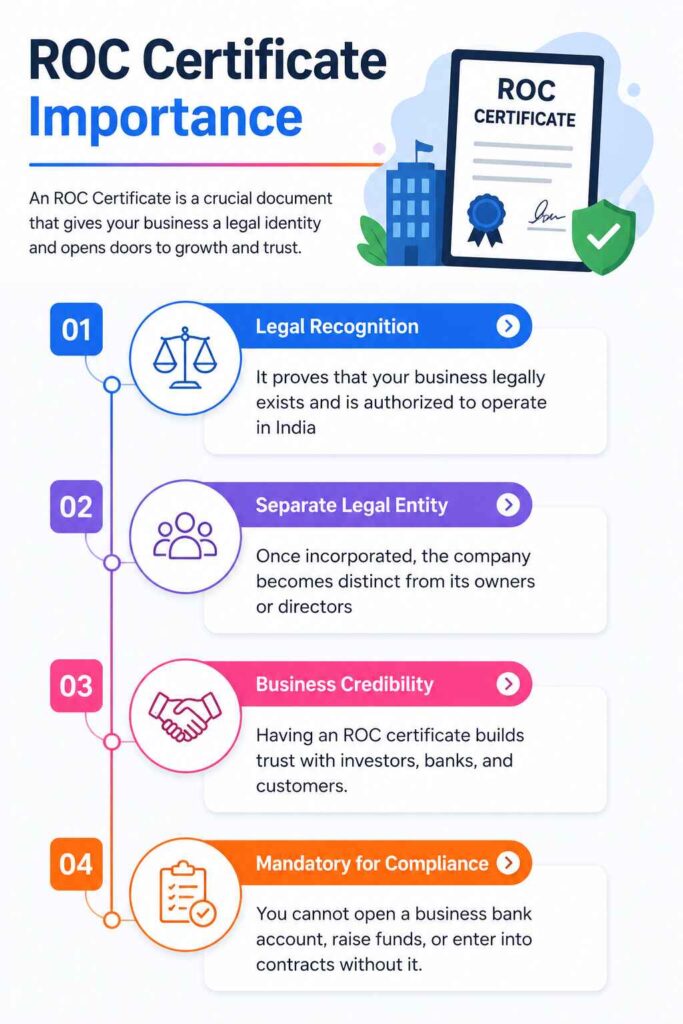
Without this certificate, your company does not legally exist in India. You cannot open a business bank account, sign contracts, raise funding, or hire employees as a legal entity. Therefore, securing the Certificate of Incorporation is always the first and most essential step in any business formation process.
Planning to register your company?
AMpuesto’s Chartered Accountants handle your incorporation from name reservation to the final Certificate of Incorporation, all through the MCA portal.
[Talk to a CA] • [Start Your Registration]
Who is Eligible for ROC Certificate?
Any entity registered under the Companies Act, 2013 or the LLP Act, 2008 receives a Certificate of Incorporation. This covers private limited companies, public limited companies, One Person Companies, LLPs, Section 8 companies, and producer companies.
Sole proprietorships, Hindu Undivided Families, and unregistered partnership firms do not register with the ROC, so they neither receive nor require this certificate.
Not sure which entity type suits your business? The choice determines your compliance load for the life of the company.
Documents Required to Get ROC Certificate
Since the ROC Certificate is the Certificate of Incorporation, the documents required are the same as those needed for company or LLP registration with the MCA.
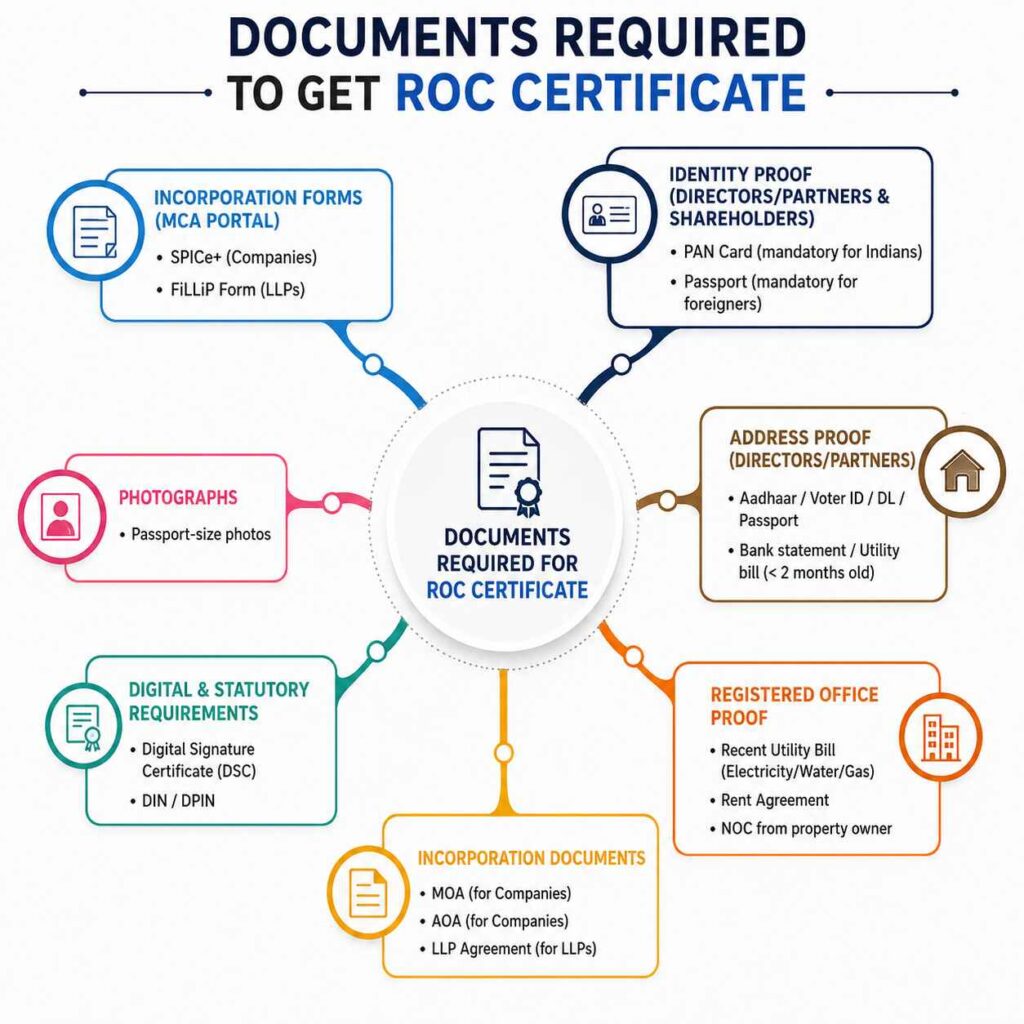
1. Identity Proof (Directors, Partners, and Shareholders)
- PAN Card (mandatory for Indian nationals)
- Passport (mandatory for foreign nationals)
2. Address Proof (Directors and Partners)
- Aadhaar Card, Voter ID, Driving Licence, or Passport
- Latest bank statement or utility bill (not older than 2 months)
3. Registered Office Proof
- Recent electricity, water, or gas bill
- Rent Agreement (if applicable)
- No Objection Certificate (NOC) from the property owner
4. Incorporation Documents
- MOA (Memorandum of Association): defines business objectives, required for companies
- AOA (Articles of Association): internal governance rules, required for companies
- LLP Agreement: governs the LLP structure, required for LLPs
These documents are issued at the time of filing the relevant incorporation forms such as SPICe+, FiLLiP, and Form 3.
5. Digital and Statutory Requirements
- Digital Signature Certificate (DSC)
- Director Identification Number (DIN) or Designated Partner Identification Number (DPIN)
6. Photographs
- Passport-size photos of all directors or partners
7. Incorporation Forms Filed on the MCA Portal
- SPICe+ for companies
- FiLLiP for LLPs
How to Get ROC Certificate: Step-by-Step via MCA Portal
The standard route to get an ROC Certificate follows the company incorporation process via the SPICe+ form on the MCA V3 portal. Here is the exact sequence:
Step 1: Secure a Digital Signature Certificate (DSC)- Get a DSC for each proposed director through any MCA-approved certifying authority. The DSC is mandatory because all documents submitted to the MCA must carry a verifiable digital signature.
Step 2: Obtain DINs or DPINs- Apply for Director Identification Numbers through the SPICe+ form for companies, or through FiLLiP for LLPs. No separate standalone DIN application is necessary at this stage.
Step 3: Reserve your company name- Use the RUN (Reserve Unique Name) service or Part A of the SPICe+ form to check name availability. The name must not conflict with any existing registered entity or trademark.
Step 4: Complete SPICe+ Part B- Fill in the full form on the MCA portal, covering business objectives, registered office address, share capital, and all director details. Attach the MOA, AOA, and any supplementary documents.
Step 5: Pay the applicable government fee- The fee scales with the company’s proposed authorised share capital.
Step 6: Receive your Certificate of Incorporation- Once MCA approves your SPICe+ form, the certificate is emailed to you as a digitally signed PDF. Approval usually takes 3 to 10 working days, depending on document checks and whether the ROC asks for any changes.
Skip the MCA portal
Let a CA team handle your company registration end to end
- Name approval, SPICe+, DIN, PAN and TAN in one filing
- Certificate of Incorporation sent to your inbox
- Professional fee from ₹14,999
Or call +91 98715 26202
Does the ROC Certificate Expire?
No. The Certificate of Incorporation is a lifetime document and never expires. It remains valid as long as your company stays active and compliant with its annual filing obligations.
However, if the ROC strikes off your company for prolonged non-compliance, the certificate effectively becomes void. In that case, you would need to apply for restoration through the National Company Law Tribunal (NCLT), which is a lengthy and costly process. So, maintaining annual compliance is always far simpler than dealing with a strike-off.
Common Misconceptions About the Certificate of Incorporation
#1 There is a government-issued document in India called the “ROC Certificate” that you need to apply for separately.
Indian law, including the Companies Act, 2013, and the LLP Act, 2008, does not use this phrase anywhere. The correct official term is Certificate of Incorporation. It is issued by the Registrar of Companies, which is how the informal nickname was born. However, in legal, banking, and compliance contexts, only the official name carries weight.
#2 Once you get the ROC Certificate, your legal obligations end.
Incorporation is merely the start. Companies must file annual returns, financial statements, and board resolutions every year. Failure to do so triggers a strike-off process, where the company is de-registered, and its bank account is frozen.
#3 Every business operating in India gets registered with the ROC and receives a Certificate of Incorporation.
The ROC only registers entities formed under the Companies Act, 2013 or the LLP Act, 2008. Sole proprietorships, Hindu Undivided Families, and unregistered general partnership firms fall completely outside the ROC’s jurisdiction. These structures are governed by separate legal frameworks and do not receive or require a Certificate of Incorporation.
#4 The Certificate of Incorporation is the only document required to start and operate a business in India.
The ROC Certificate only proves that your company exists as a legal entity. It does not certify compliance with tax laws, labour laws, local municipal regulations, or sector-specific rules. Furthermore, companies with share capital must file Form INC-20A (Declaration of Commencement of Business) within 180 days of incorporation before they can legally begin operations.
Conclusion
The ROC Certificate, officially known as the Certificate of Incorporation, is the foundation of every company registration in India. It establishes your business as a separate legal entity and serves as official proof that your company is recognised under Indian law.
Already incorporated?
AOC-4 is due 30 October 2026. Late filing costs ₹100 per day.
- AOC-4 and MGT-7 filed by a CA team
- Financials and director details checked before filing
- Private limited annual filing from ₹3,999
Or call +91 98715 26202
FAQs
Q1. Is an ROC Certificate the same as a Certificate of Incorporation?
Yes. ROC Certificate is the informal name people use for the Certificate of Incorporation.
Q2. How do I download my ROC Certificate?
Check the email used for your SPICe+ filing first. If you can’t find it, log in to mca.gov.in, go to View Public Documents, pay the fee, and download the Certificate of Incorporation from My Workspace.
Q3. Is the ROC Certificate free to download?
The original certificate is emailed free when your company is incorporated. Downloading a copy later from the MCA portal requires a small fee, and certified copies have a separate fee.
Q4. How long does it take to get an ROC Certificate?
Typically 3 to 10 working days, depending on document verification and MCA approval.
Q5. Does the ROC Certificate expire?
No. It stays valid for the life of the company, as long as annual filings are kept current.
Q6. What if I lose my ROC Certificate?
You can get a copy any time from the MCA portal through View Public Documents, after paying the fee. Your company’s records stay on MCA permanently.
Q7. Can a company start business right after incorporation?
Not always. Companies with share capital must file Form INC-20A within 180 days first.