Introduction
In India’s corporate world, director disqualification ranks among the most serious compliance penalties that any professional can face. Many directors discover they are disqualified only when their Director Identification Number (DIN) stops working.
Section 164 of the Companies Act, 2013 governs the entire framework for director disqualification in India. It lays down specific grounds, triggers automatic consequences, and sets out a restoration pathway that demands prompt and careful action.
This guide covers the exact legal grounds under Section 164(1) and Section 164(2), the consequences for your DIN, and the forms you must file.
What is Director Disqualification?
Director disqualification is the legal condition in which a person becomes ineligible to act as, be appointed as, or continue as a director of a company in India.
Disqualification under Section 164 operates on two distinct tracks. The first track covers personal defaults attributable directly to the individual director. The second track covers corporate defaults, where the company’s non-compliance triggers disqualification for all its directors.
Personal Defaults: Section 164(1)
Section 164(1) lists eight grounds on which a person becomes ineligible for appointment as a director due to their own personal conduct or legal status.
1. Unsound Mind
A person declared to be of unsound mind by a competent court cannot serve as a director. The court declaration is a prerequisite; the disqualification does not arise merely from a mental health condition.
2. Undischarged Insolvent
Any person who is an undischarged insolvent is automatically disqualified. Additionally, if a person has applied for adjudication as an insolvent and that application is still pending, the disqualification applies during the pendency of the application.
3. Criminal Conviction
A person who has been convicted by a court of any offence, whether or not it involves moral turpitude, and sentenced to imprisonment for six months or more, faces disqualification for five years after the expiry of that sentence. Moreover, if the sentence is seven years or more, the disqualification becomes permanent, and the person can never serve as a director in any company.
4. Non-Payment of Share Call Money
If a person holds shares in a company and has not paid the call money due on those shares for more than six months from the last date fixed for payment, the person becomes disqualified.
5. Court or Tribunal Order
If any court or tribunal has passed an order specifically disqualifying a person from being appointed as a director, and that order is currently in force, the person cannot serve as a director anywhere.
6. Conviction for Related Party Transaction Offences
A person convicted of any offence related to related party transactions under Section 188 of the Companies Act, 2013 within the last five years faces disqualification.
7. Non-Compliance with DIN Requirements
Failure to comply with Section 152(3) of the Companies Act, which requires every director to obtain and hold a valid Director Identification Number (DIN), also triggers disqualification.
Key Point About Section 164(1) Disqualifications
Most practicing directors will never encounter these personal grounds, as they relate to serious individual failures. However, the corporate-level grounds under Section 164(2) are far more common and affect far more directors each year.
Corporate Defaults: Section 164(2)
This sub-section focuses on the company’s failures rather than the individual’s personal behavior.
Under Section 164(2), a person who is or has been a director of a company that has committed certain defaults becomes disqualified from being reappointed in that company or appointed in any other company for a period of five years from the date on which the company first defaulted.
Default Ground A: Non-Filing of Annual Returns or Financial Statements
If a company fails to file its annual return (Form MGT-7) or its financial statements (Form AOC-4) for any three consecutive financial years, every director of that company faces disqualification under Section 164(2)(a).
Default Ground B: Failure to Repay Deposits, Redeem Debentures, or Pay Dividends
If a company fails to repay accepted deposits or pay the interest on them, or fails to redeem its debentures on the due date or pay interest on them, or fails to pay any declared dividend, and this failure continues for one year or more, Section 164(2)(b) triggers disqualification for all directors.
Important Exception: Newly Appointed Directors
The law provides a six-month grace period for directors who join a company already in default. After six months, however, the disqualification applies fully.
Exception for Government Companies
Section 164(2) does not apply to Government Companies, as notified via G.S.R. 463(E) dated 5 June 2015.
Consequences of Director Disqualification
Once a director incurs disqualification under Section 164, the effects are immediate, wide-ranging, and publicly visible.
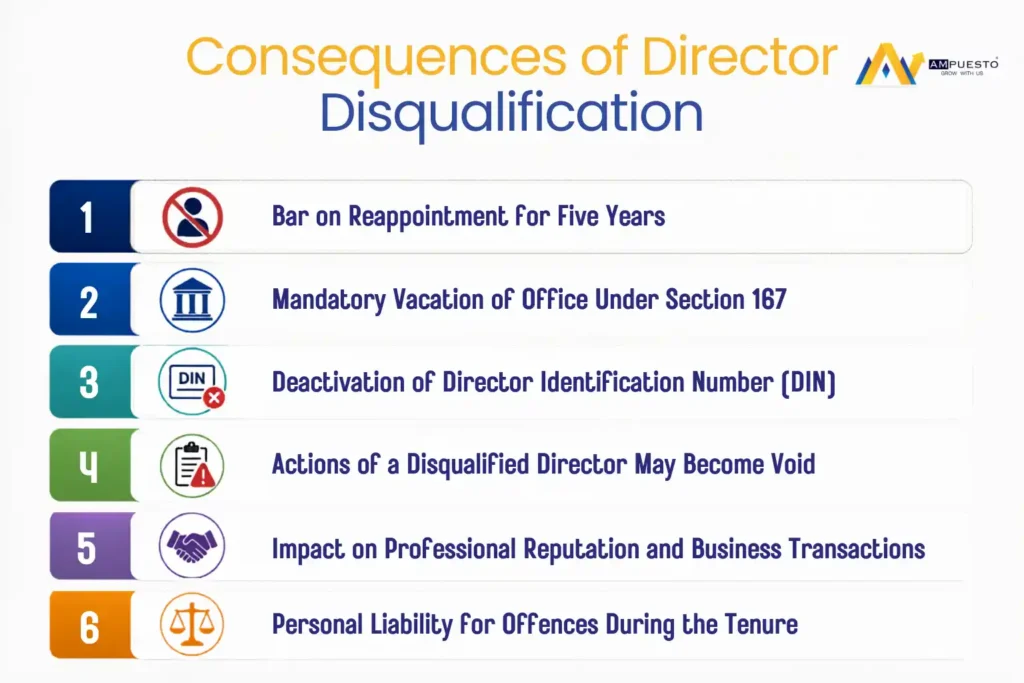
1. Bar on Reappointment for Five Years
A disqualified director cannot be reappointed in the defaulting company or appointed as a director in any other company for five years from the date of the default.
2. Mandatory Vacation of Office Under Section 167
Section 167 of the Companies Act, 2013 works in conjunction with Section 164. Once a director becomes disqualified under Section 164(2), Section 167 requires that the director vacate office in all companies where they hold a directorship, except the defaulting company. This legal proviso ensures that the disqualified director remains on the board of the non-compliant company specifically to rectify the defaults and clear the filing backlogs.
3. Deactivation of Director Identification Number (DIN)
The Ministry of Corporate Affairs (MCA) deactivates the DIN of disqualified directors. A deactivated DIN means the director cannot digitally sign any company filings, cannot access MCA V3 portal services in a directorial capacity, and cannot be associated with any company on the MCA database. The DIN deactivation is public and visible to anyone who searches the MCA portal.
4. Actions of a Disqualified Director May Become Void
Any actions or decisions taken by a director after disqualification may carry legal risk and could be deemed invalid.
5. Impact on Professional Reputation and Business Transactions
Banks routinely verify director profiles before approving business loans. Investors conduct DIN status checks as part of standard due diligence.
6. Personal Liability for Offences During the Tenure
Importantly, disqualification does not erase liability for offences committed while the person held the directorship. Consequently, a disqualified director may still face prosecution, fines, or penalties for non-compliance that occurred during their tenure as a director.
Mandatory Compliance Forms: What Directors and Companies Must File
When disqualification occurs or is anticipated, both the director and the company must complete specific regulatory filings. Failing to complete these filings creates further compliance violations.
| Form Name | Who Files It? | Purpose / Deadline |
|---|---|---|
| DIR-8 | Disqualified Director | Intimation given to the company regarding the disqualification status. |
| DIR-9 | The Company | Report sent to the ROC within 30 days of receiving DIR-8. |
| DIR-10 | Disqualified Director | Application for removal of disqualification ( filed after the 5-year block or via court order). |
| DIR-11 | Resigning Director | Notice of resignation filed directly with the ROC to cut ties with a non-compliant company. |
How to Check and Resolve Director Disqualification Status
Step 1: Verify Your DIN Status on the MCA Portal
To check whether your DIN is active or disqualified, visit the MCA V3 portal at mca.gov.in.
- Navigate to “MCA Services,”
- Then select “DIN Services,”
- Followed by “Verify DIN/Director Details.”
- Enter your eight-digit DIN number to see the current status.
- The portal will display one of three statuses: “Active,” “Deactivated,” or “Disqualified.”
Step 2: Identify the Source of Disqualification
If your DIN shows as deactivated or disqualified, the next step is to identify which company’s default triggered the problem.
Step 3: File Overdue Returns for the Defaulting Company
Filing the overdue financial statements and annual returns. However, note that filing overdue documents alone does not automatically remove the disqualification. Additional legal steps are still required.
Step 4: File Form DIR-8 and Form DIR-9
As described above, the director must file Form DIR-8 with the company, and the company must file Form DIR-9 with the Registrar. These filings are a prerequisite before submitting any application for removal of disqualification.
Step 5: File Form DIR-10 for Removal of Disqualification
Form DIR-10 is an application for the removal of disqualification, but it cannot be filed immediately after clearing defaults. Legally, you can only file either after the 5-year disqualification period expires, or earlier if you successfully obtain a favorable order from the High Court or NCLT.
Step 6: Approach the NCLT or File a Writ Petition
One of the most effective routes to remove disqualification is approaching the National Company Law Tribunal (NCLT) or filing a writ petition before the relevant High Court.
Step 7: Take Advantage of Government Condonation Schemes
Periodically, the Ministry of Corporate Affairs introduces temporary Condonation of Delay Schemes (such as past CODS or CFSS schemes). These amnesty windows allow defaulting companies and directors to file overdue documents with reduced penalties and reactivate their status.
How to Prevent Director Disqualification
Most director disqualifications in India are entirely preventable. The following practices protect compliant directors from inadvertently stepping into disqualification territory.
1. File statutory documents on time, without exception.
2. Monitor compliance in all your directorships.
3. Check your DIN status every quarter.
4. Resign formally from non-compliant companies.
5. Engage a qualified company secretary or chartered accountant.
Also Read: [How to Change a Company Director]
FAQs
Q1. What is the disqualification period under Section 164(2)?
Five years from the date the company first committed the default.
Q2. Can a disqualified director still hold shares in the company?
Yes. Disqualification affects only the directorship, not shareholding rights.
Q3. Does filing pending annual returns remove disqualification automatically?
No. Filing overdue returns is necessary but not sufficient. Additional legal steps such as DIR-8, DIR-9, DIR-10, or an NCLT application are still required.
Q4. Does Section 164 apply to LLPs?
No. Section 164 applies only to companies under the Companies Act, 2013, not to LLPs governed by the LLP Act, 2008.
Q5. Can a newly appointed director in a defaulting company avoid disqualification?
Yes, for six months from the date of appointment. After that, full disqualification applies.
Q6. What is the difference between Section 164(1) and Section 164(2)?
Section 164(1) covers personal grounds such as insolvency or criminal conviction. Section 164(2) covers company-level defaults like non-filing of returns, and it disqualifies all directors of that company automatically.