Starting a business comes with one big decision. Which structure should you choose?
Many founders today prefer a Limited Liability Partnership because it offers flexibility with protection. You get the operational ease of a partnership while keeping your personal assets safe. That balance makes LLP one of the most practical choices for startups, professionals, and small businesses in India.
Let’s break down the complete LLP registration process in India in a way that actually makes sense. No jargon. No confusion.
What is a Limited Liability Partnership (LLP)?
A Limited Liability Partnership is a separate legal entity registered under the LLP Act, 2008. It allows partners to run a business while limiting their liability to their agreed contribution.
In simple terms, if the business faces losses, your personal assets stay protected.
Who Should Choose LLP?
Before jumping into registration, it helps to know if LLP fits your needs.
LLP works best for:
- Freelancers and consultants
- Small business owners
- Service-based startups
- Family-run businesses
However, if you plan to raise funding from investors, a Private Limited Company may suit you better.
Eligibility Criteria for LLP Registration
To register an LLP in India, you must meet the following conditions:
- Minimum two partners are required
- At least two designated partners must be individuals
- One designated partner must be a resident of India
- Partners can be individuals or corporate entities
Also, there is no upper limit on the number of partners.
Documents Required for LLP Registration
Getting your documents ready early speeds up the process.
For Partners:
- PAN Card (mandatory for Indian nationals)
- Aadhaar Card or Passport
- Address proof, such as a bank statement or a utility bill
- Passport-sized photograph
For Registered Office:
- Electricity bill or utility bill not older than 2 months
- No Objection Certificate from the property owner
Additional Documents:
- Subscriber sheet
- Digital Signature Certificate
Step-by-Step LLP Registration Process in India
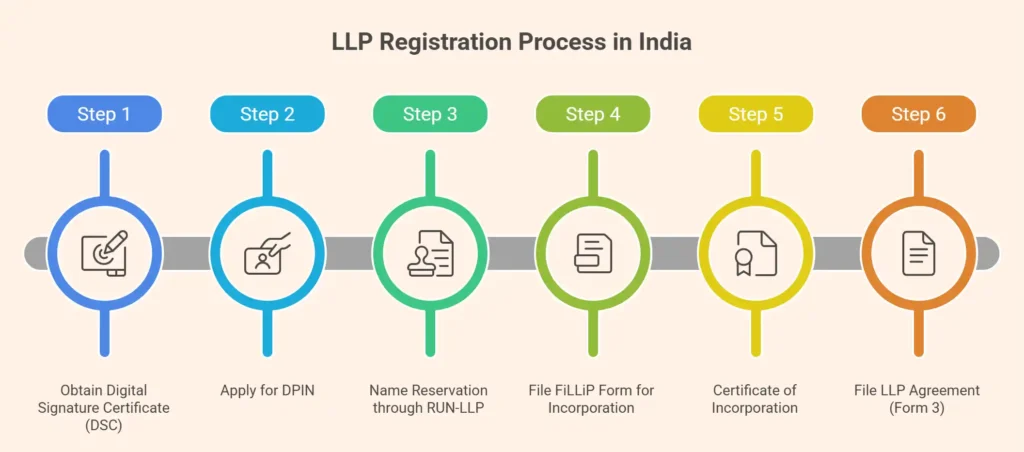
Now let’s walk through the actual process step by step.
Step 1: Obtain Digital Signature Certificate (DSC)
Since LLP registration is fully online, all designated partners must have a Digital Signature Certificate. It is used to sign forms electronically.
Step 2: Apply for DPIN
DPIN stands for Designated Partner Identification Number. You can apply for it directly through the incorporation form for up to two partners.
Step 3: Name Reservation through RUN-LLP
Next, you need to reserve your LLP name.
Here’s what to keep in mind:
- You can submit two name options
- The name must be unique
- It should not violate trademarks
- It must end with “LLP”
Once approved, the name remains valid for 3 months.
Step 4: File FiLLiP Form for Incorporation
This is the main registration step.
The FiLLiP form includes:
- Partner details
- Registered office address
- Capital contribution
- DPIN allotment
After submission, the Registrar of Companies reviews your application.
Step 5: Certificate of Incorporation
If everything is correct, you receive the Certificate of Incorporation. At this point, your LLP legally exists.
Step 6: File LLP Agreement (Form 3)
Within 30 days of incorporation, you must file the LLP Agreement.
This document defines:
- Roles and responsibilities
- Profit-sharing ratio
- Rights and duties of partners
Post-Incorporation Compliance for LLP
Registration is just the beginning. After that, you must follow certain compliances.
- File Form 11 (Annual Return)
- File Form 8 (Statement of Accounts)
- Maintain proper books of accounts
- Apply for GST if applicable
- Open a business bank account
Missing deadlines can lead to heavy penalties, so consistency matters.
LLP Registration Fees in India
The cost of LLP registration depends on multiple factors.
Government Fees:
- Name reservation: around ₹200
- Incorporation fees: based on contribution amount
- Stamp duty: varies by state
Other Costs:
- DSC: ₹1000 to ₹2000 per partner
- Professional fees: depend on the service provider
Overall, the total cost usually ranges between ₹6,000 to ₹15,000.
Time Required for LLP Registration
The process is quite fast if the documents are ready.
- DSC and DPIN: 1 to 2 days
- Name approval: 1 to 3 days
- Incorporation: 4 to 7 days
So, you can register an LLP in about 10 to 15 working days.
Advantages of LLP
LLP offers several benefits, which is why it is growing in popularity.
- Limited liability protection
- Separate legal identity
- Lower compliance compared to other companies
- No minimum capital requirement
- Flexibility in management
Disadvantages of LLP
While LLP has benefits, it also comes with limitations.
- Difficult to raise funding from investors
- Higher penalties for non-compliance
- Limited growth perception compared to Private Limited
Common Mistakes to Avoid
Many applications get delayed due to simple mistakes.
Avoid these:
- Choosing similar or trademarked names
- Submitting incorrect documents
- Delaying LLP Agreement filing
- Ignoring compliance deadlines
Conclusion
LLP registration in India is now simpler than ever. The process is digital, structured, and relatively quick.
However, what really matters is doing it right the first time. When you follow the correct steps, prepare documents in advance, and stay compliant, you build a strong legal foundation for your business.
If your goal is to run a flexible business with limited liability and lower compliance, LLP is a solid choice.
FAQs
1. How long does it take to register an LLP in India?
It usually takes around 10 to 15 working days, depending on document readiness and approvals.
2. Is GST mandatory for LLP?
GST is required only if your turnover exceeds the threshold or if your business falls under mandatory GST registration categories.
3. Can one person start an LLP?
No, at least two partners are required to register an LLP in India.
4. What is the minimum capital required for LLP?
There is no minimum capital requirement. You can start with any amount.
5. Is LLP better than a Private Limited Company?
It depends on your goals. LLP is better for small businesses and professionals, while Private Limited suits startups looking for funding.
6. Can a foreign national become a partner in LLP?
Yes, foreign nationals can become partners, but at least one designated partner must be an Indian resident.
7. Is audit mandatory for LLP?
Audit is required only if turnover exceeds ₹40 lakh or capital contribution exceeds ₹25 lakh.