Introduction
Every tax season in India, one question keeps coming back: What is the real difference between Form 16 and Form 16A? Both are TDS certificates. Both matter for your income tax return. Yet they serve very different purposes, and mixing them up is one of the most common filing mistakes people make.
So whether you draw a salary, freelance, or earn from several sources, knowing which certificate applies to you can save you from mismatches, notices, and last-minute stress. This guide keeps it simple and practical.
What Is Form 16?
Form 16 is the TDS certificate your employer gives you at the end of each financial year. In short, it confirms that your employer deducted tax on your salary under Section 192 and deposited it with the government. So think of it as your official salary-tax receipt.
Form 16 comes in two parts.
Part A: The TDS Summary
Part A shows the tax your employer deducted and deposited each quarter. Specifically, it carries:
- Your name and PAN
- The employer’s name, address, PAN, and TAN
- The assessment year and financial year
- A quarter-by-quarter summary of TDS deducted and deposited
- The acknowledgement numbers of the TDS returns
The employer pulls Part A directly from the TRACES portal, so it carries a unique certificate number. Therefore, treat Part A as the verified, government-stamped record of your salary TDS.
Part B: The Salary Breakup
Part B explains how your tax was worked out. The employer prepares it, and it covers:
- Gross salary for the year
- Exemptions such as HRA and LTA
- Deductions under Chapter VI-A (Section 80C, 80D, and more)
- Net taxable income
- Tax computed, TDS already paid, and any balance due or refundable
So Part B does most of the heavy lifting when you file, because it hands you a ready summary of your salary and deductions.
Quick example: Rahul, a software engineer in Bengaluru earning Rs. 12 lakh a year, receives Form 16 by mid-June. First, he uses Part A to match his TDS against Form 26AS. Then, opting for the old tax regime to claim his investments, he uses Part B to fill ITR-1 with the right salary, HRA, and 80C figures.
What Is Form 16A?
Form 16A is the TDS certificate for non-salary income. So whenever anyone other than your employer deducts tax on a payment to you, they must give you Form 16A. For example, a bank deducts tax on your fixed deposit interest, or a client deducts tax on your consulting fee under Section 194J.
Unlike Form 16, which arrives once a year, Form 16A arrives every quarter. So if four clients deduct TDS on your fees through the year, you should collect 16 certificates in total before you file.
Who usually receives Form 16A? Mainly freelancers, consultants, professionals like doctors and lawyers, landlords, and agents with non-salary income that attracts TDS. Moreover, salaried people get it too, for instance, when a bank deducts tax on their FD interest.
Common Transactions That Trigger Form 16A
- Interest on FDs and recurring deposits (Section 194A)
- Professional and technical fees (Section 194J)
- Contractor payments (Section 194C)
- Commission and brokerage (Section 194H)
- Rent above the threshold (Section 194I)
Quick example: Priya, a freelance UI/UX designer, earns Rs. 5 lakh a year from a Pune startup that deducts 10% TDS each quarter under Section 194J. The startup issues Form 16A after each quarterly TDS return. So Priya collects all four and claims the TDS credit while filing ITR-4.
Form 16 vs Form 16A: Key Differences
| Parameter | Form 16 | Form 16A |
|---|---|---|
| Issued by | Employer | Any deductor (bank, client, company) |
| Recipient | Salaried employees | Freelancers, consultants, vendors, landlords |
| Income covered | Salary only | Professional fees, FD interest, rent, commission |
| TDS section | Section 192 | Sections 194A, 194C, 194H, 194I, 194J, and others |
| Certificate rule | Section 203 | Section 203 |
| Frequency | Once a year | Every quarter (four times a year) |
| Due date | By 15 June after the FY ends | Within 15 days of the TDS return due date |
| ITR role | Main document for salary income | Essential for claiming non-salary TDS credits |
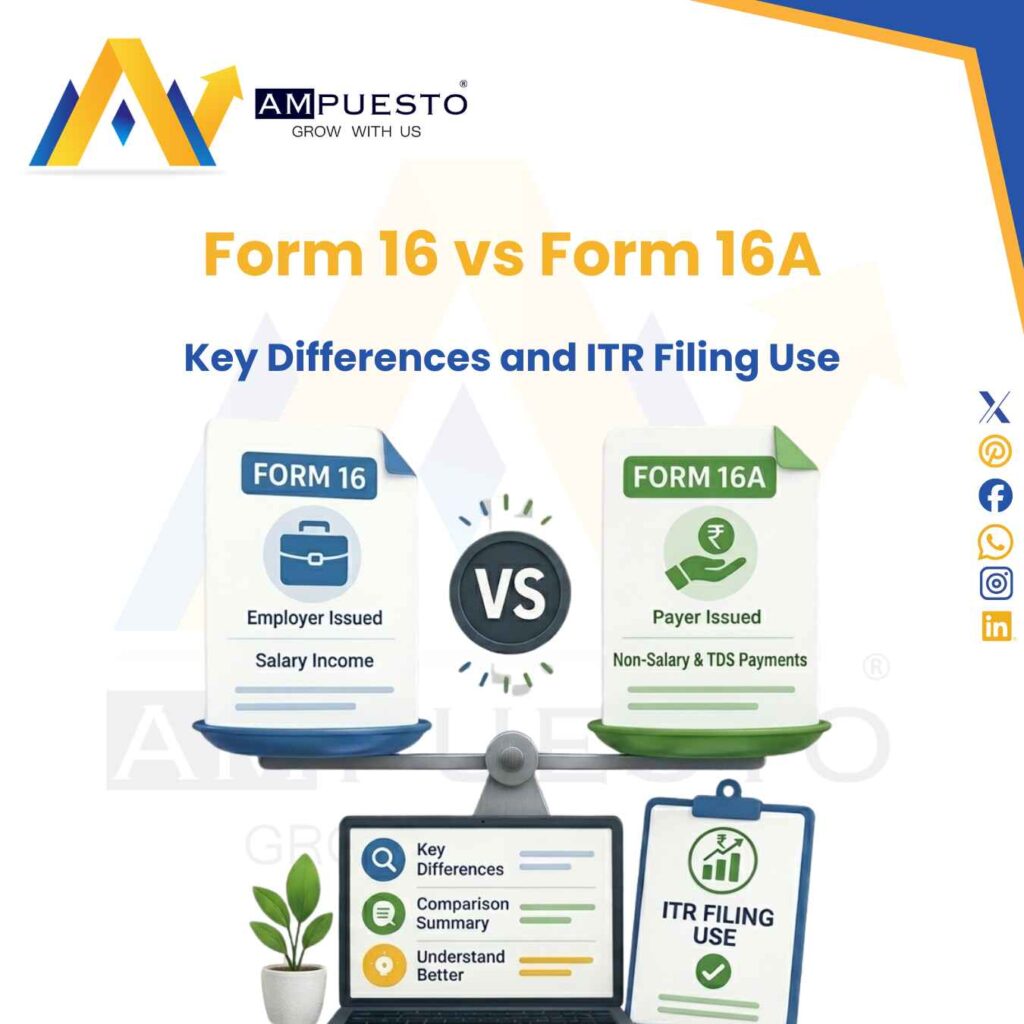
In short, Form 16 means salary TDS once a year from your employer. Form 16A means non-salary TDS every quarter from the deductor.
Here is one nuance worth remembering. A salaried person can hold both. So if you keep a fixed deposit, your bank issues Form 16A for the interest TDS, even though your employer already gave you Form 16 for salary.
A Quick Note on TDS Thresholds
Before you chase a missing certificate, check whether TDS even applied:
- FD interest for most individuals: TDS starts above Rs. 50,000 a year (earlier Rs. 40,000)
- FD interest for senior citizens: TDS starts above Rs. 1 lakh a year (earlier Rs. 50,000)
- Rent under Section 194I: TDS applies above Rs. 50,000 a month
- Professional or technical fees under Section 194J: TDS applies above Rs. 50,000 a year
- Commission and brokerage under Section 194H: TDS applies above Rs. 20,000 a year
So if a payment stayed below these limits, you may not get a Form 16A at all. Even then, you must still report that income in your return.
Which Certificate Do You Need? (By Taxpayer Profile)
Different taxpayers collect different combinations. So use this quick reference to spot your case and the likely ITR form.
| Your profile | Form 16 | Form 16A | Likely ITR form |
|---|---|---|---|
| Salaried, no other income | Yes | No | ITR-1 |
| Salaried plus FD interest | Yes | Yes (bank) | ITR-1 or ITR-2 |
| Salaried plus side consulting | Yes | Yes (client) | ITR-3 or ITR-4 |
| Full-time freelancer or consultant | No | Yes (all clients) | ITR-3 or ITR-4 |
| Landlord with TDS on rent | No | Yes (tenant or company) | ITR-1 or ITR-2 |
| Multiple employers in one year | Yes (one each) | Possibly | ITR-1 or ITR-2 |
The takeaway is simple. Your income mix, not just your salary status, decides how many certificates you collect and which form you file. So getting this right early saves hours of corrections later. If you are unsure which form fits, our income tax return filing service can sort it out for you.
When Do You Receive These Certificates?
Form 16 Due Date
Employers must issue Form 16 by 15 June after the financial year ends. So for FY 2025-26, you should have it by 15 June 2026. Also, if you switched jobs during the year, collect a separate Form 16 from each employer, since you need both for an accurate return.
Form 16A Due Dates (Quarterly)
| Quarter | Period | TDS return due | Form 16A due |
|---|---|---|---|
| Q1 | April to June | 31 July | 15 August |
| Q2 | July to September | 31 October | 15 November |
| Q3 | October to December | 31 January | 15 February |
| Q4 | January to March | 31 May | 15 June |
How to Download Form 16 and Form 16A
Both certificates come from the TRACES portal (tdscpc.gov.in). Employers download Part A of Form 16, and deductors download Form 16A, once they file their TDS returns. So you usually receive them by email, an HR portal, or a direct request to the company or bank. The file may be password-protected, so check the format with the issuer if it does not open.
Have you not received your Form 16A yet? Then log in to the income tax e-filing portal (incometax.gov.in) and open your AIS or Form 26AS. Both reflect every TDS entry against your PAN. So even without the physical certificate, you can verify your credit and file on time. Our step-by-step guide on how to download your AIS walks you through it.
Which Form Do You Need for ITR Filing?
If you are salaried, start with Form 16. It gives you the salary breakup, HRA exemption, and TDS details you need for ITR-1(for simple salary income) or ITR-2(if you also have capital gains or multiple house properties).
If you earn non-salary income from consulting, FD interest, or rent, then Form 16A matters just as much. Without it, you might miss TDS credits you are legally owed. Worse, if a TDS entry shows in Form 26AS but not in your ITR, the system can flag a mismatch and send a notice.
Missing a certificate? Then use your AIS, Form 26AS, salary slips, and bank statements instead. These count as accepted records for rebuilding your income and TDS details. And if you spot an error after filing, you can still fix it with an updated return (ITR-U).
Common Mistakes to Avoid
Even careful filers slip up here. So watch out for these:
1. Mixing up the forms: Treating Form 16 and 16A as identical and entering data into the wrong fields on the ITR portal.
2. Ignoring bank TDS: Assuming you don’t need to report FD interest just because the bank deducted TDS. It remains fully taxable based on your slab.
3. Omitting a previous employer: Forgetting to get Form 16 from your old company after a mid-year job switch, which leads to incorrect tax calculations.
4. Skipping the 26AS/AIS check: Filing without reconciling your certificates against government records, risking automated tax notices.
5. Picking the wrong ITR form: Filing a basic ITR-1 out of habit when freelance or consulting income actually requires ITR-3 or ITR-4.
6. Leaving it until July: Waiting until the last minute to chase issuers. Check your e-filing portal around mid-June when most data is uploaded.
7. Losing track of clients (Freelancers): Failing to track who deducted your TDS. If a client misses their return deadline, your Form 16A won’t generate.
8. Missing low-interest FD income: Assuming no TDS means no tax. If a senior citizen earns under Rs. 1 lakh in FD interest, no Form 16A is issued, but the income must still be declared.
File Smart, File Once
Here is the bottom line. Form 16 covers salary TDS, and your employer issues it once a year. Form 16A covers non-salary TDS, and banks, companies, or clients issue it every quarter. Both feed straight into your ITR, and you should match both against Form 26AS before you file.
So collect every certificate early, reconcile each one against your AIS, and report all income honestly. Do that, and filing becomes quick, clean, and notice-free.
Need a Hand With Your Filing?
Tax certificates and ITR forms can get confusing fast, especially with side income or multiple employers. So if you would rather hand it to experts, AMpuesto files your return accurately and on time. Explore our ITR filing service or TDS and TCS return service, or simply talk to our team.
FAQs
1. What is the main difference between Form 16 and Form 16A?
Form 16 covers salary income from your employer. Form 16A covers non-salary income like FD interest, rent, and professional fees from other deductors.
2. Can a salaried employee get Form 16A?
Yes. If your bank deducts TDS on FD interest, it issues Form 16A, even though your employer gives you Form 16 for salary.
3. Is Form 16 mandatory to file ITR?
No, you do not upload it. However, it makes salary filing far easier, and you can rebuild the data from salary slips, AIS, and Form 26AS if needed.
4. My TDS shows in Form 26AS, but I have no Form 16A. What should I do?
You can still claim the credit using Form 26AS or AIS. Meanwhile, ask the deductor for the certificate, since they must issue it once they file the return.
5. How many Form 16As can I receive in a year?
There is no fixed limit. You get one per deductor per quarter, so several clients plus a bank can mean a dozen or more in a year.