Introduction
Running a company in India means more than earning revenue. Every registered company must also report to the Registrar of Companies (ROC) each year, and each form carries its own deadline. Miss one, and the penalties add up fast, sometimes at Rs 100 a day with no cap.
So this guide lays out the full ROC compliance calendar in plain terms. You will see every key form, what it does, when it falls due, and who must file it. Most of these deadlines repeat on the same dates each year, since they hang off fixed points like the financial year end and the AGM. So once you learn the rhythm, it repeats. Director KYC is now the exception, having moved to a three-year cycle from 31 March 2026. Whether you run a private limited company, an OPC, or a dormant company, this checklist keeps you on the right side of the Ministry of Corporate Affairs (MCA). Let us begin with the calendar at a glance.
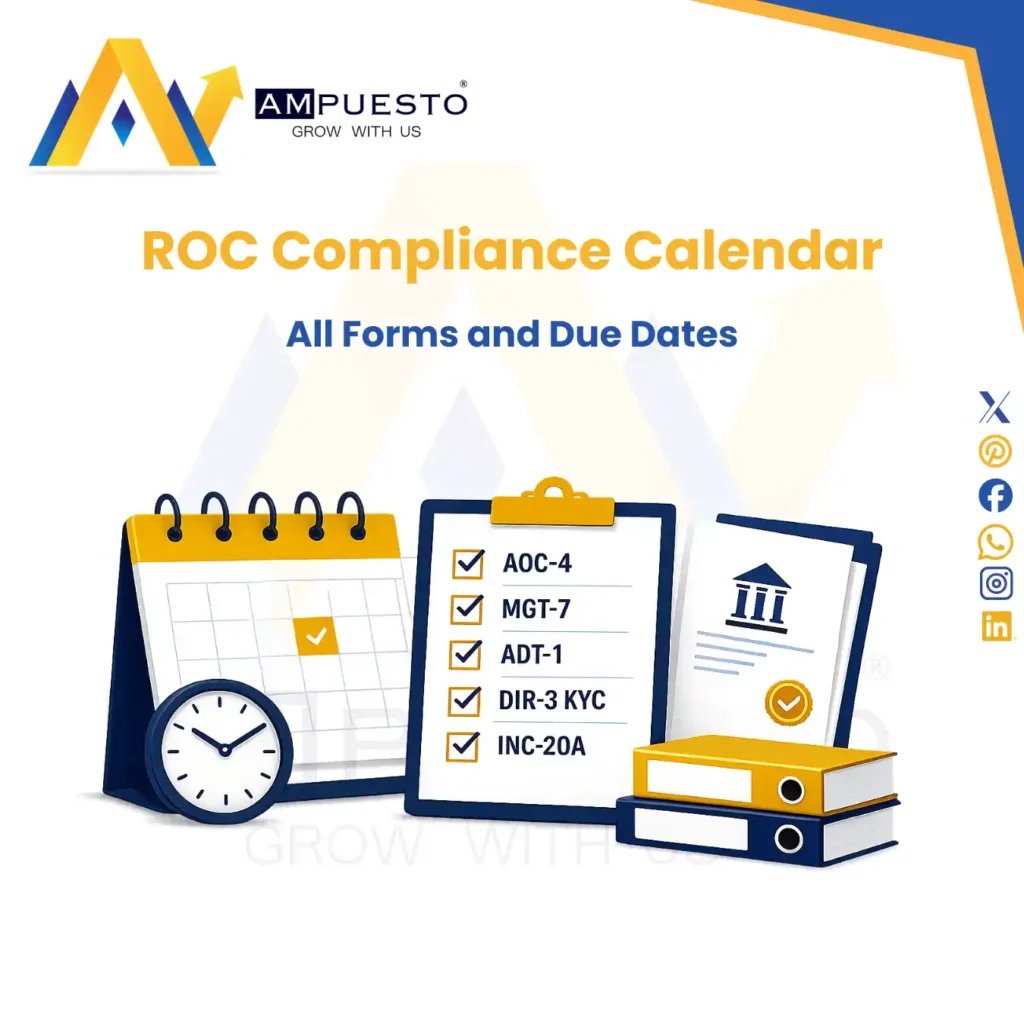
ROC Compliance Calendar
A master calendar for a company with a 31 March financial year-end. Most dates flow from the AGM, which a company must hold by 30 September. So most of the calendar below repeats on these same dates every year. Director KYC is the one exception, since it now runs on a three-year cycle.
| Form | Purpose | Due date | Applies to |
|---|---|---|---|
| AGM | Annual General Meeting | By 30 September | All companies except OPC |
| ADT-1 | Auditor appointment intimation | Within 15 days of AGM | All companies |
| AOC-4 | Financial statements | Within 30 days of AGM (around 30 October) | All companies |
| MGT-7 / MGT-7A | Annual return | Within 60 days of AGM (around 29 November) | All companies |
| INC-20A | Commencement of business | Within 180 days of incorporation | New companies with share capital |
| MSME-1 | Dues to MSME suppliers (Oct to Mar) | 30 April | Companies with MSME dues over 45 days |
| DPT-3 | Return of deposits and loans | 30 June | Non-government companies with loans/deposits |
| DIR-3 KYC Web | Director KYC | 30 June, once every third financial year | Every DIN holder |
| MSME-1 | Dues to MSME suppliers (Apr to Sep) | 31 October | Companies with MSME dues over 45 days |
When your AGM lands earlier than 30 September, your AOC-4 and MGT-7 dates move earlier too, since both count from the AGM date. So always start the clock from your actual AGM, not from the calendar’s last-day assumption. Now let us break down each form.
AOC-4: Filing Your Financial Statements
AOC-4 is your company’s financial report card. Through it, you submit the balance sheet, profit and loss account, cash flow statement, auditor’s report, and board’s report to the ROC. You must file it within 30 days of your AGM.
A few variants apply in special cases:
- AOC-4 CFS: companies with subsidiaries file this for consolidated statements.
- AOC-4 XBRL: larger companies file in a structured, machine-readable format, covered below.
- AOC-4 NBFC (Ind AS): NBFCs following Ind AS use this variant.
- CSR-2: companies covered by CSR under Section 135 also file this.
One critical nuance for solo founders: an OPC holds no AGM, so its AOC-4 deadline does not depend on an AGM date. Instead, an OPC must file AOC-4 within 180 days from the close of the financial year, which works out to 27 September.
AOC-4 XBRL: Who Must File It?
XBRL stands for eXtensible Business Reporting Language, a tagging format that makes financial data machine-readable. Once a company enters XBRL, it must keep filing that way every year, even if its numbers later drop below the limit.
You must file AOC-4 in XBRL if you fall into any of these groups:
- Public companies listed on an Indian stock exchange (and their Indian subsidiaries)
- All unlisted companies with paid-up capital of Rs 5 crore or more
- All unlisted companies with turnover of Rs 100 crore or more
- Companies that prepare financial statements under Indian Accounting Standards (Ind AS)
Most small companies and OPCs stay outside this, so they file the regular AOC-4. Banking, insurance, NBFC, and housing finance companies follow their own sector formats.
MGT-7 and MGT-7A: Your Annual Return
While AOC-4 covers the money, MGT-7 covers everything else. It captures your registered office, shareholding pattern, directors, changes during the year, and turnover and net worth. So it works like your company’s yearly identity record. You file it within 60 days of the AGM.
Which form applies to you?
- MGT-7A: small companies and OPCs file this shorter version.
- MGT-7: every other company files the full return.
- MGT-8 certification: listed companies must obtain this. So must any unlisted company that crosses either threshold, meaning paid-up share capital of Rs 10 crore or more, or turnover of Rs 50 crore or more. The two tests are independent, so crossing one is enough. Certification is by a practising Company Secretary in Form MGT-8.
ADT-1: Auditor Appointment
When your company appoints or reappoints a statutory auditor at the AGM, you inform the ROC through ADT-1. You must file it within 15 days of the AGM. Even though an auditor usually serves a five-year term, you still file ADT-1 at the appointment. So do not skip it in the appointment year.
DIR-3 KYC Web: Director KYC (Now Triennial)
Director KYC is no longer an annual filing. Through the Companies (Appointment and Qualification of Directors) Amendment Rules, 2025, notified vide G.S.R. 943(E) dated 31 December 2025 and effective from 31 March 2026, MCA substituted Rule 12A. Every person holding a DIN as on 31 March of a financial year now files Form DIR-3 KYC Web once every third consecutive financial year, on or before 30 June.
The two earlier forms are gone. DIR-3 KYC and DIR-3 KYC-Web have been merged into a single Form DIR-3 KYC Web, which handles routine compliance, reactivation, and updates.
When your filing falls due
Your cycle runs from the financial year in which your DIN was allotted. MCA has published illustrations:
- DIN allotted on or before 31 March 2025, and KYC already filed for FY 2025-26: nothing due in FY 2026-27 or FY 2027-28. First filing falls between April and June 2028.
- DIN allotted during FY 2025-26: first filing falls between April and June 2029.
The 30-day update rule still applies
If your mobile number, email ID, or residential address changes, you must file DIR-3 KYC Web within 30 days of the change along with the prescribed fee, whatever stage of the three-year cycle you are in. This update runs on a separate track and does not reset your triennial cycle.
Miss your due date and MCA deactivates the DIN. Reactivation costs a flat Rs 5,000 per director. So the filing is rarer now, but the consequence of forgetting it is the same.
INC-20A: Commencement of Business
This one is a one-time filing for new companies. If your company has share capital and you incorporated it on or after 2 November 2018, you must file INC-20A within 180 days of incorporation. It declares that your shareholders have paid in their subscribed capital.
Skip it, and the cost stings: a Rs 50,000 penalty on the company, plus Rs 1,000 per day on each officer in default, capped at Rs 1,00,000 per officer.
DPT-3: Return of Deposits and Loans
Most non-government companies must file Form DPT-3 annually by 30 June for the financial year ending 31 March. It reports both public deposits and exempted receipts (such as loans from directors, bank credit lines, or inter-company borrowings). If your company has any outstanding loans or advances on 31 March, you must file DPT-3 even if you have zero public deposits. (Government companies and companies with zero outstanding debts/loans are exempt).
MSME-1: Dues to MSME Suppliers
If your company owes an MSME supplier for more than 45 days, you must report it in MSME-1. This is a half-yearly filing:
- For October to March, file by 30 April.
- For April to September, file by 31 October.
The government watches delayed MSME payments closely, so file on time to avoid penalties under Section 405.
Other Filings Worth Knowing
- PAS-6: unlisted public companies reconcile their share capital every half year.
- MGT-14: you file this within 30 days whenever the board passes certain resolutions.
- LLPs follow a separate track: Form 11 by 30 May and Form 8 by 30 October.
Government Fees for Filing
The MCA charges a normal filing fee based on your authorised share capital:
| Authorised share capital | Normal fee |
|---|---|
| No share capital | Rs 200 |
| Less than Rs 1,00,000 | Rs 200 |
| Rs 1,00,000 to Rs 4,99,999 | Rs 300 |
| Rs 5,00,000 to Rs 24,99,999 | Rs 400 |
| Rs 25,00,000 to Rs 99,99,999 | Rs 500 |
| Rs 1 crore or more | Rs 600 |
What Happens If You File Late?
Late filing hurts, so treat every deadline seriously. Here is what a delay costs:
- AOC-4 and MGT-7: an extra Rs 100 per day, with no upper cap, from the due date until you file.
- DIR-3 KYC Web: the MCA deactivates the DIN, and reactivation costs Rs 5,000 per director.
- INC-20A: Rs 50,000 on the company, plus Rs 1,000 per day on each officer in default, capped at Rs 1,00,000 per officer.
- MSME-1 and DPT-3: penalties under the Act, which can climb quickly.
If a company fails to file its financial statements or annual returns for three straight years, its directors face disqualification for five years under Section 164(2). So the Rs 100-a-day clock is only the start.
How to File: A Simple Checklist
Follow this rhythm each year, and compliance stays smooth:
1. Hold your AGM within six months of the financial year end, and get shareholders to approve the accounts.
2. Keep the audited balance sheet, profit and loss account, cash flow statement, and the board’s and auditor’s reports ready.
3. Convert to XBRL if your company crosses the limits, then validate it with the MCA tool.
4. Log in to the MCA V3 portal, complete AOC-4, and attach the financial statements. It must be signed by the Directors (and certified by a practicing CA/CS/CMA if the company does not qualify as a Small Company).
5. File MGT-7 or MGT-7A within 60 days of the AGM. Note that valid Digital Signature Certificates (DSC) of the Directors are required for signing both AOC-4 and MGT-7/7A e-Forms.
6. Pay the fee online, then save the acknowledgement (SRN) for your records.
Managing all of this alongside your business is not easy. So if the calendar feels overwhelming, our private limited annual filing service handles every form and deadline for you.
Conclusion
Most ROC compliance runs on a fixed annual rhythm. Hold your AGM by 30 September, file AOC-4 within 30 days, file MGT-7 within 60 days, and slot in ADT-1, DPT-3, and MSME-1 on their own dates. Director KYC now sits outside that rhythm, falling due once every third financial year by 30 June. On top of that, check whether your size pushes you into XBRL, and file INC-20A right after incorporation.
So mark these dates early, keep your financials audit-ready, and you will glide through the year without that daily penalty clock ticking. When anything feels unclear, a quick word with a practising CA or CS saves both time and money.
Stay Ahead of Every ROC Deadline
Missed forms turn into penalties, and even director disqualification. So rather than track it all yourself, let our team manage your annual filings end-to-end. Explore our annual compliance service for private limited companies and OPCs, or talk to our experts today.
Frequently Asked Questions
1. What is the ROC compliance calendar?
It is the set of annual and periodic MCA filing deadlines every company must meet, such as AOC-4, MGT-7, ADT-1, DIR-3 KYC, DPT-3, and MSME-1.
2. What are the due dates for AOC-4 and MGT-7?
For a March year-end with the AGM on 30 September, AOC-4 falls due by 30 October and MGT-7 by 29 November.
3. Is ROC filing mandatory for a company with no business?
Yes. Every registered company must file its annual forms, even with zero transactions during the year.
4. What is the penalty for late ROC filing?
AOC-4 and MGT-7 attract Rs 100 per day with no cap. Missing DIR-3 KYC Web deactivates the DIN, with a Rs 5,000 reactivation fee.
5. Who has to file DIR-3 KYC?
Every person holding a DIN as on 31 March must file it, whether or not they are an active director. Since 31 March 2026 the filing is due once every third financial year, by 30 June.
6. What is INC-20A, and when is it due?
INC-20A declares the start of business. New companies with share capital must file it within 180 days of incorporation.
7. Is DIR-3 KYC still due on 30 September?
No. From 31 March 2026 the due date moved to 30 June, and the filing is now once every three financial years instead of annually.