
India has officially moved into a new tax era. The Income Tax Act, 2025 is now in force from 1 April 2026, replacing the six-decade-old Income Tax Act, 1961.
Here’s the thing. This is not just a routine update. It’s a structural reset aimed at simplifying compliance, reducing disputes, and making taxation easier to understand for both individuals and businesses.
Let’s break it down in a way that actually makes sense.
Why a New Income Tax Act Was Needed
For years, the old tax law kept expanding with amendments, explanations, and exceptions. Over time, it became complex, hard to interpret, and compliance-heavy.
Now, the government has taken a clean-slate approach.
What this really means is:
- Fewer sections
- Clearer language
- Less legal ambiguity
- More digital-first processes
The goal is simple. Make taxation easier to follow and harder to misuse.
Key Highlights of the Income Tax Act, 2025
1. Completely Restructured Law
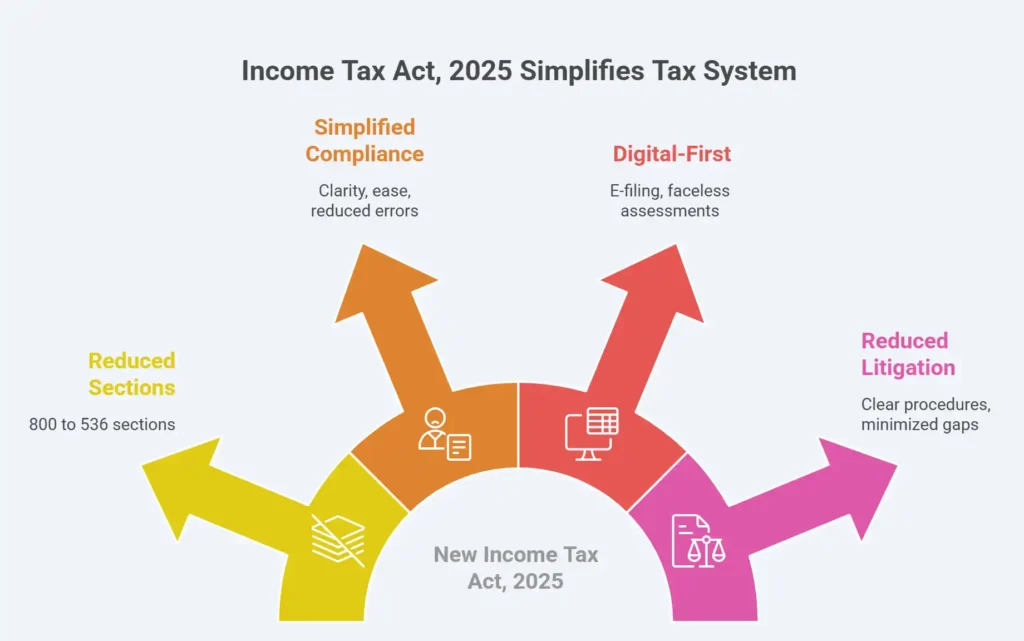
The new act reduces the law from over 800 sections to 536 sections, organized into a more logical structure.
As a result:
- Redundant provisions are removed
- Similar rules are merged
- Language is simplified for better clarity
2. Effective from 1 April 2026
The act is already live. All financial transactions from FY 2026–27 onward fall under this new framework.
So, whether you are:
- A salaried employee
- A business owner
- A startup founder
You are now operating under the new law.
3. Focus on Simplified Compliance
Earlier, compliance often meant confusion. Now, the law focuses on clarity and ease.
For example:
- Definitions are standardized
- Processes are streamlined
- Filing requirements are more structured
Because of this, both individuals and companies can reduce compliance errors.
4. Digital-First Tax System
The new act strongly pushes a digital-first approach.
This includes:
- Improved e-filing systems
- Faceless assessments
- Reduced physical interaction
As a result, transparency increases while disputes reduce.
5. Objective: Reduce Litigation
One of the biggest pain points in the old system was tax litigation.
Now:
- Procedures are clearly defined
- Thresholds are better structured
- Interpretation gaps are minimized
This shift is expected to significantly reduce long-standing tax disputes.
Important Changes You Should Know
1. Standard Deduction Continues
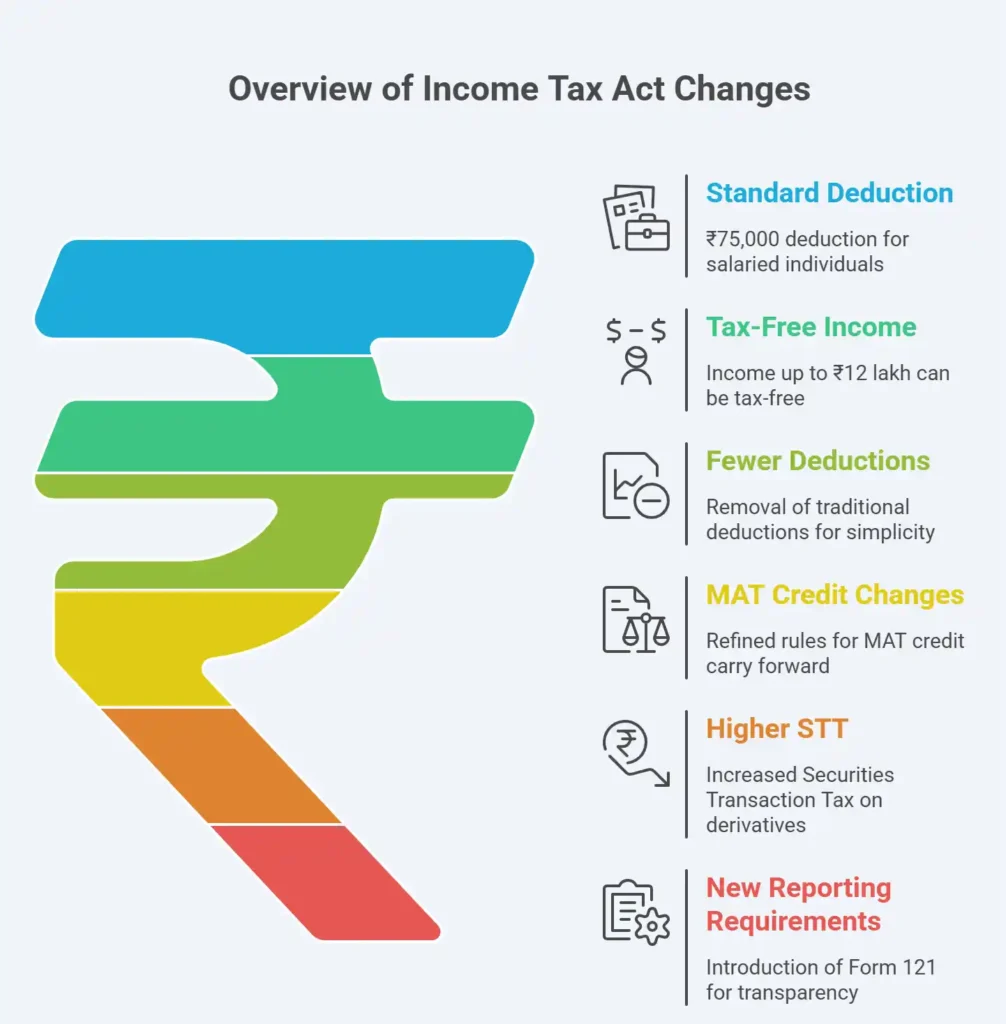
A ₹75,000 standard deduction remains available for salaried individuals under the new regime.
So, salaried taxpayers still get basic relief without needing multiple deductions.
2. Income Up to ₹12 Lakh Effectively Tax-Free
Due to rebates under Section 87A:
- Income up to ₹12 lakh can become tax-free under the new regime
- This depends on eligibility and conditions
This is a big relief for middle-income taxpayers.
3. Fewer Deductions, Cleaner Structure
The new regime continues to remove many traditional deductions like:
- Section 80C
- Section 80D
- HRA exemptions in many cases
Instead, it offers lower tax rates with fewer complications.
4. MAT Credit Changes
Minimum Alternate Tax rules are refined:
- MAT credit carry forward continues
- However, usage is capped more strictly
This ensures better alignment with the simplified tax structure.
5. Higher STT on Derivatives
Securities Transaction Tax has been revised:
- Futures: Increased to 0.05%
- Options: Increased to 0.15%
So, traders and investors need to factor in slightly higher transaction costs.
6. New Reporting Requirements
A new compliance element has been introduced:
- Form 121 must be submitted to each payer in certain cases
This helps improve transparency and data matching.
Old vs New Tax System: What’s the Real Shift?
Let’s simplify this.
| Aspect | Old System | New System |
|---|---|---|
| Structure | Complex and layered | Simplified and structured |
| Deductions | Many options | Limited options |
| Tax Rates | Higher | Lower |
| Compliance | Heavy | Streamlined |
| Litigation | High | Expected to reduce |
So, the shift is clear. Less complexity, more predictability.
Who Benefits the Most?
1. Salaried Individuals
If you prefer a straightforward system without managing multiple deductions, the new regime works better.
2. Startups and Businesses
Simplified compliance and clearer rules help reduce legal overhead.
3. Digital Economy Participants
Freelancers, creators, and online businesses benefit from structured reporting and digital processes.
Challenges You Should Be Aware Of
Not everything is perfect.
- Those who relied heavily on deductions may see higher tax liability
- Businesses must adapt to new compliance formats
- Transition understanding will take time
However, once adapted, the system becomes easier to manage.
Final Thoughts
The Income Tax Act, 2025 is less about changing tax rates and more about changing how taxation works in India.
It moves the system:
- From complex to clear
- From manual to digital
- From interpretative to structured
If you understand the shift early, you can plan your taxes smarter and avoid unnecessary surprises.
FAQs
1. What is the Income Tax Act, 2025?
It is the new tax law that replaces the Income Tax Act, 1961, effective from 1 April 2026, designed to simplify tax compliance and reduce complexity.
2. Is the old income tax act still applicable?
No, the Income Tax Act, 1961 has been replaced for transactions from FY 2026–27 onwards.
3. What are the major benefits of the new tax regime?
Lower tax rates, fewer deductions, simplified compliance, and reduced chances of litigation.
4. Is income up to ₹12 lakh tax-free?
Yes, under certain conditions due to rebates, income up to ₹12 lakh can effectively become tax-free.
5. Should I choose the new tax regime or old one?
The new regime works better if you prefer simplicity. However, if you rely heavily on deductions, you should calculate both options before deciding.