
Starting a business takes vision. Scaling it takes support.
In India, startup incentives and subsidies play a major role in helping new ventures survive early pressure and grow faster. If you’re building an innovative company, understanding these government schemes for startups can significantly reduce costs and improve your cash flow.
Let’s break it down clearly.
What Qualifies as a Startup in India?
An entity registered as a Private Limited Company, LLP, or Partnership Firm may qualify as a startup if it:
- Is less than 10 years old
- Has an annual turnover below ₹100 crore
- Focuses on innovation, development, or improvement of products/services
- Is not formed by splitting an existing business
Most benefits apply once you obtain DPIIT recognition.
Why Startup Incentives in India Matter
Early-stage companies face:
- High operational expenses
- Limited revenue
- Difficulty accessing capital
Startup subsidies and incentives help by:
- Reducing compliance burden
- Offering tax exemptions
- Improving access to funding
- Supporting R&D and intellectual property
- Encouraging job creation
These measures directly reduce early-stage financial stress and improve operational runway.
Major Government Schemes for Startups in India
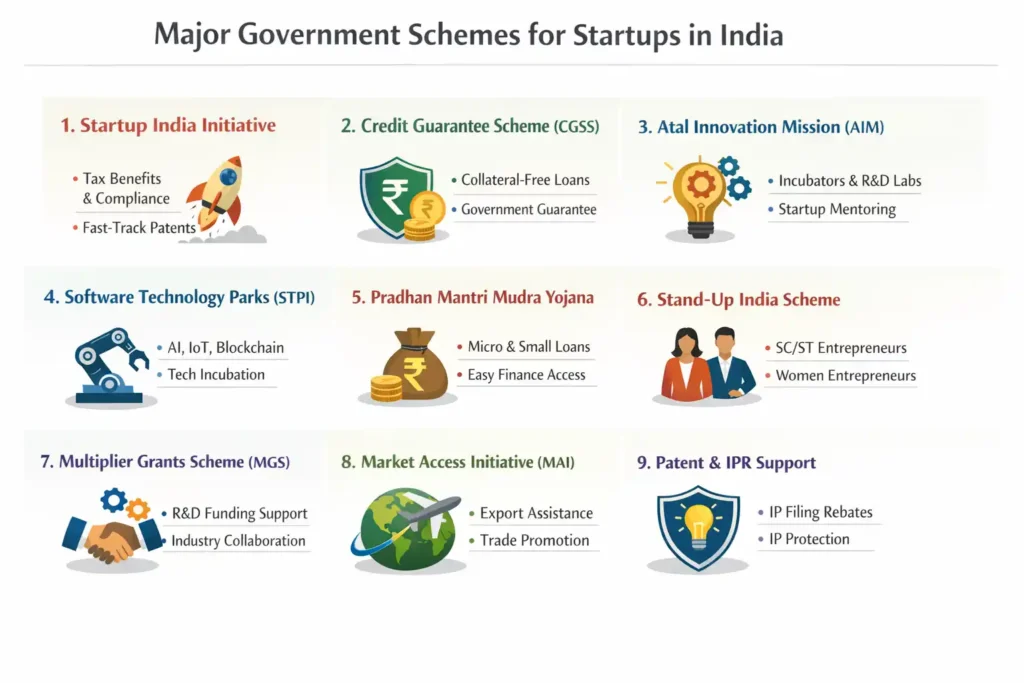
1. Startup India Initiative
Launched in 2016, the Startup India program provides structural and financial support to eligible businesses.
Key Startup India Benefits
- Self-certification compliance under selected labour and environmental laws
- Three-year income tax exemption under Section 80-IAC
- Angel tax exemption under Section 56
- 80% rebate on patent filing fees
- Fast-track patent examination
- Simplified exit process under IBC
- Access to Government e-Marketplace (GeM)
For many founders, this is the starting point for accessing broader startup incentives in India.
2. Credit Guarantee Scheme for Startups (CGSS)
Access to capital is one of the biggest challenges.
The Credit Guarantee Scheme provides collateral-free loans for startups by offering a government-backed guarantee to banks and financial institutions.
If a DPIIT-recognised startup defaults, the government covers a portion of the lender’s loss. This reduces risk and improves approval chances.
This is especially useful for founders without personal assets to pledge.
3. Atal Innovation Mission (AIM)
The Atal Innovation Mission focuses on building innovation infrastructure.
It supports:
- Incubators
- R&D programs
- Early-stage innovation labs
- Startup mentoring networks
If you’re building a tech-driven or research-heavy venture, AIM can be valuable.
4. Software Technology Parks of India (STPI)
STPI supports tech startups working in:
- Artificial Intelligence
- IoT
- Blockchain
- Robotics
- Machine Learning
It offers incubation, mentoring, and infrastructure across multiple centers in India, including Tier-2 and Tier-3 cities.
5. Pradhan Mantri Mudra Yojana (PMMY)
PMMY offers collateral-free loans for small businesses and micro enterprises.
Loans are available through banks, NBFCs, and microfinance institutions. This scheme is especially helpful for early-stage service, manufacturing, and trading businesses.
6. Stand-Up India Scheme
Designed to promote inclusive entrepreneurship, this scheme supports:
- SC/ST entrepreneurs
- Women entrepreneurs
Key features include:
- Loans between ₹10 lakh and ₹1 crore
- Repayment up to 7 years
- Credit guarantee support
7. Multiplier Grants Scheme (MGS)
This scheme encourages industry-academic collaboration.
If a company funds an R&D project, the government provides matching financial support up to twice the industry contribution. Ideal for tech startups focused on indigenous innovation.
8. Market Access Initiative (MAI) Scheme
Planning to export?
MAI supports international expansion through:
- Trade fairs and exhibitions
- Brand building
- Packaging improvements
- Overseas marketing campaigns
This is particularly useful for export-oriented startups.
9. Patent and IPR Support for Startups
Protecting intellectual property is critical.
Recognised startups receive:
- 80% rebate on patent filing
- 50% rebate on trademark filing
- Government-paid IP facilitators
- Fast-track examination
Strong IP protection improves valuation and investor confidence.
Comparison of Major Startup Schemes in India
| Scheme | Type of Support | Best For | Direct Funding? |
|---|---|---|---|
| Startup India Initiative | Compliance relief, tax benefits, IP support | Scalable innovation-led startups | No (benefit-based) |
| Credit Guarantee Scheme (CGSS) | Government-backed loan guarantee | Asset-light startups seeking bank loans | Indirect (loan-backed) |
| Atal Innovation Mission (AIM) | Incubation & ecosystem development | Deep-tech and research-focused ventures | Mostly indirect |
| STPI | Infrastructure & incubation support | IT/ITES and export-oriented tech startups | No |
| PM Mudra Yojana (PMMY) | Collateral-free business loans | Micro & small businesses | Yes (loan) |
| Stand-Up India | Bank loans for SC/ST & women founders | Inclusive entrepreneurship | Yes (loan) |
| Multiplier Grants Scheme (MGS) | Matching R&D grants (subject to approval) | Industry-academia innovation projects | Yes (grant, conditional) |
| Market Access Initiative (MAI) | Export promotion & marketing support | Export-oriented startups | Yes (cost support) |
| Patent & IPR Support | Fee rebates & fast-track processing | IP-intensive startups | No (cost reduction) |
How to Maximize Startup Subsidies
To fully benefit from startup incentives in India:
- Obtain DPIIT recognition
- Track eligibility carefully
- Maintain proper documentation
- Monitor compliance timelines
- Consult legal and financial advisors when required
The opportunities are real. But execution matters.
Common Mistakes Founders Make
- Assuming automatic eligibility
- Ignoring IMB approval for tax exemption
- Missing state-level subsidies
- Poor documentation
- Applying after funding rounds
Execution matters more than awareness.
Final Thoughts
Startup subsidies and government schemes for startups are not just financial perks. They are growth accelerators. If used strategically, they reduce burn rate, improve credibility, and help founders focus on innovation instead of survival. Before diluting equity, assess whether non-dilutive government support can reduce your capital requirement.
FAQs
a) Financial and non-financial government benefits
b) Include tax exemptions and funding support
c) Reduce compliance burden
d) Encourage innovation
a) DPIIT recognised startups
b) Less than 10 years old
c) Turnover below ₹100 crore
d) Focused on innovation
Yes.
Yes.
a) Obtain DPIIT recognition
b) Apply through official government portals
c) Submit required documents
d) Meet eligibility criteria
a) Reduces innovation cost
b) Speeds up approval
c) Protects intellectual property
d) Increases investor confidence