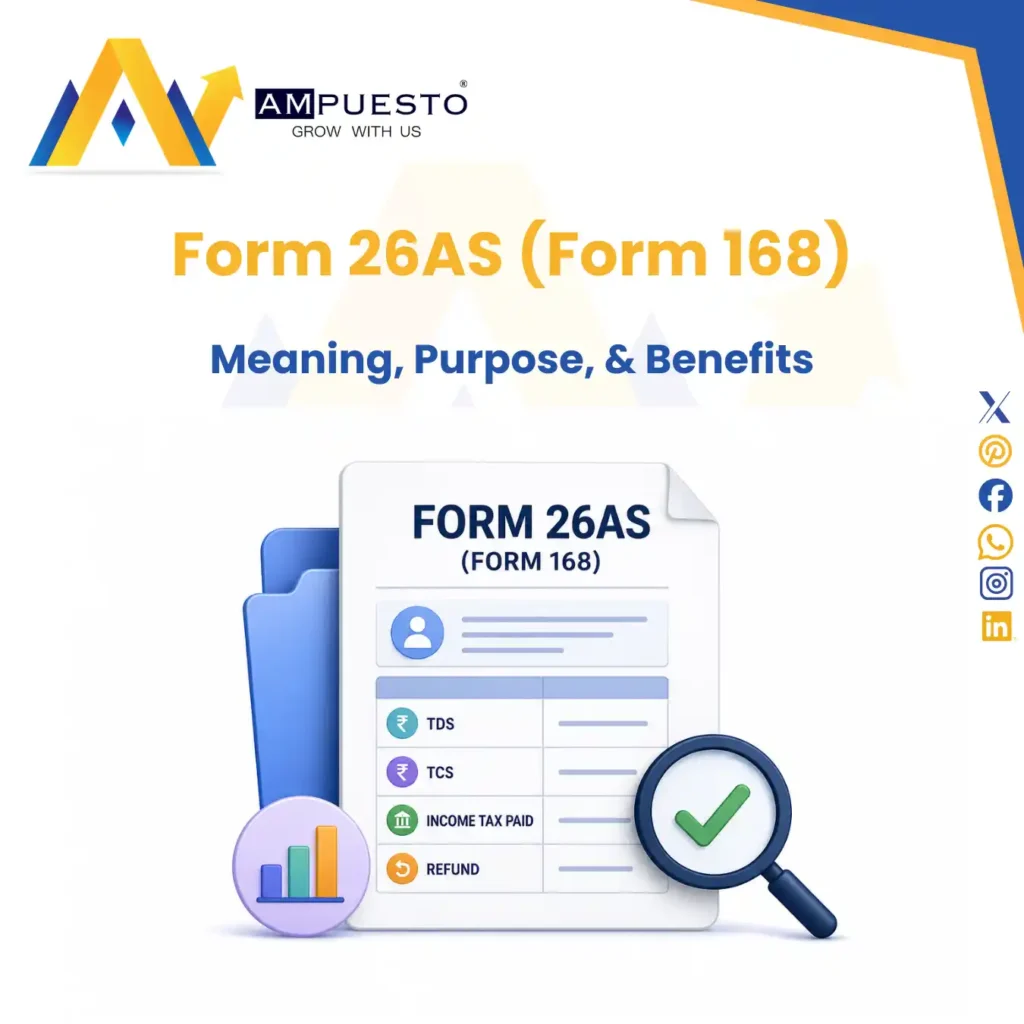
Note: As of April 2026, Form 26AS is transitioning to Form 168 under the new tax regime. The details below apply to both.
Introduction
If you file taxes in India, Form 26AS (Form 168) is not optional reading. It is one of the most important documents you will ever use during ITR filing.
Think of it as your tax passbook. It records every tax-related activity linked to your PAN. However, many taxpayers either ignore it or misunderstand it. That is where problems begin.
Here’s the thing. A single mismatch between your return and Form 26AS (Form 168) can trigger notices, delay refunds, or even lead to penalties.
So let’s break it down in a simple, practical way.
What is Form 26AS (Form 168)?
Form 26AS (Form 168) is a consolidated annual tax statement issued by the Income Tax Department of India. It shows all taxes deducted, collected, or paid on your behalf during a financial year.
It includes:
- Tax Deducted at Source (TDS)
- Tax Collected at Source (TCS)
- Advance tax and self-assessment tax
- Tax refunds received
- High-value financial transactions
- Details of tax proceedings
In short, it is your complete tax activity record for the year.
Why Form 26AS (Form 168) Matters More Than You Think
Many people check their salary slips or bank statements. Very few verify Form 26AS (Form 168). That’s a mistake.
Here’s why it matters:
- It confirms whether deducted tax is actually deposited with the government
- It helps you claim the correct tax credit
- It prevents errors while filing ITR
- It acts as proof of income and tax compliance
Important insight:
Form 26AS (Form 168) is now primarily your tax credit record, while income-level visibility has largely shifted to AIS.
What this really means is simple. If your Form 26AS (Form 168) is wrong, your ITR will also be wrong.
Components of Form 26AS (Form 168) Explained
Form 26AS (Form 168) is divided into multiple sections. Each one serves a specific purpose.
1. Part A – TDS Details
Shows tax deducted by employers, banks, or other deductors.
2. Part B – TCS Details
Includes tax collected on transactions like high-value purchases and foreign remittances.
3. Part C – Advance Tax & Self-Assessment Tax
Shows taxes paid directly by you.
4. Part D – Refund Details
Displays refunds issued by the department.
5. Part E – High-Value Transactions
Earlier, more detailed, but now many transaction-level insights are reflected in AIS.
6. Part F – TDS on Property
Shows TDS on property purchases.
7. Part G – TDS Defaults
Highlights filing issues.
8. Part H – Proceedings
Shows tax-related proceedings.
How to Download Form 26AS (Form 168)
You can access it easily:
- Visit the Income Tax e-Filing portal
- Log in using your PAN
- Go to e-File → Income Tax Returns → View Form 26AS
- Redirect to TRACES portal
- Download in PDF or HTML
2026 Update:
The TRACES system is now faster, and access is also available through select authorized banking platforms.
Purpose of Form 26AS (Form 168)
1. Ensures Transparency
Gives a clear picture of taxes deducted and deposited.
2. Helps in Accurate ITR Filing
Allows cross-verification before submission.
3. Prevents Mismatch Issues
Reduces chances of notices and delays.
4. Supports GST Reconciliation
For business owners, turnover visible in tax records should align with GST filings. Mismatch can trigger scrutiny.
Key Benefits of Form 26AS (Form 168)
- Reduces risk of tax notices
- Ensures correct tax credit
- Works as financial proof for loans and visas
- Helps detect errors or non-deposit of TDS
- Supports better financial planning
Form 26AS (Form 168) vs AIS: What You Should Actually Check?
| Feature | Form 26AS (Form 168) | AIS |
|---|---|---|
| Primary Role | Your Tax Credit Record | Your Financial Activity Record |
| Focus | TDS, TCS, tax paid | Income, investments, transactions |
| Legal Use | Final for claiming tax credits | Basis for income reporting |
| Key Insight | What tax is paid | What income is earned |
When to use what:
- Use Form 26AS (Form 168) to verify tax credits
- Use AIS to verify total income
If there is a mismatch, always fix credits using 26AS but validate income using AIS.
Common Mistakes to Avoid
- Not checking Form 26AS (Form 168) before filing
- Ignoring TDS mismatches
- Claiming excess tax credit
- Not following up for missing entries
Here’s where most people go wrong. They trust Form 16 blindly and skip 26AS. That’s risky.
Practical Example
Let’s understand with a simple case.
- Employer deducted ₹50,000 as TDS
- Bank deducted ₹5,000 on FD interest
- Total TDS = ₹55,000
Now suppose Form 26AS shows only ₹50,000.
That means ₹5,000 is missing. You must contact your bank before filing your return.
If you ignore this, you may lose that tax credit.
Conclusion
Form 26AS (Form 168) is not just another document. It is the backbone of accurate tax filing.
Before filing your ITR:
- Check Form 26AS (Form 168)
- Match all entries
- Fix mismatches early
This one step can save you from notices, delays, and lost tax credits.
FAQs
Yes, under the new framework, Form 26AS is transitioning into Form 168, mainly for tax credit reporting.
Start with AIS for income, then verify tax credits using Form 26AS (Form 168).
Because AIS tracks full financial activity, while 26AS focuses only on tax credits.
Yes. Income mismatch or incorrect credit claims can trigger scrutiny.
It may reflect turnover indicators, which should match GST filings for businesses.