
Form ADT-3 is the resignation statement a statutory auditor files with the Registrar of Companies under Section 140(2) of the Companies Act, 2013. It records that the auditor has stepped down and why.
Quick answers:
- Who files it: the resigning auditor, not the company
- Deadline: 30 days from the date of resignation
- Where: MCA V3 portal, as a web form since 14 July 2025
- Government fee: from ₹200, based on the company’s nominal share capital
- Penalty for missing it: ₹50,000 or the auditor’s remuneration, whichever is lower, plus ₹500 per day, capped at ₹2,00,000
- New requirement: the SRN of the original ADT-1 must be quoted
The rest of this guide covers each of these in detail, including the document checklist and the eight-step filing process on V3.
What Is Form ADT-3?
Form ADT-3 is a statutory form mandated under Section 140(2) of the Companies Act, 2013, used by auditors to notify the Registrar of Companies (ROC) about their resignation from a company. This compliance measure ensures that companies maintain transparency in their financial operations and uphold corporate governance standards.
The law clearly states:
- An auditor who resigns must file ADT-3 within 30 days of resignation.
- The filing must clearly state reasons for resignation, relevant facts, and supporting details.
This ensures that both the company and the auditor are compliant with statutory requirements.
ADT-3 Form Purpose
The core purpose of Form ADT-3 is to maintain transparency. It provides the government with a clear picture of why the auditor left and whether the resignation impacts financial integrity.
In simple terms, ADT-3 helps track:
- Whether the auditor resigned due to disagreements
- Whether there were issues in the financial statements
- Whether the auditor found something that needed disclosure
- Whether it was a normal exit after internal or personal reasons
It protects the auditor, safeguards stakeholders, and reinforces accountability.
Who Must File Form ADT-3
Only the resigning auditor files ADT-3.
This applies to:
- Individual auditors
- Audit firms
- LLPs acting as auditors
- Auditors of both private and public companies
The company does not file this form. Its job is to fill the casual vacancy after the resignation.
ADT-3 Due Date: 30 Days From Resignation
The ADT-3 due date is 30 days from the date of resignation, not from the date the company accepts it and not from the date of the board meeting. The clock starts the day the auditor’s resignation takes effect.
There is no extension mechanism and no seasonal deadline. The 30 days run independently for every resignation.
| Date of Resignation | Last Date to File ADT-3 |
|---|---|
| 1 April 2026 | 1 May 2026 |
| 15 June 2026 | 15 July 2026 |
| 30 September 2026 | 30 October 2026 |
| 1 August 2026 | 31 August 2026 |
If the last day falls on a holiday, the MCA V3 portal still accepts filings, so plan for the calendar date rather than the working day.
ADT-3 Filing Fees
The government fee for ADT-3 follows the standard MCA slab under the Companies (Registration Offices and Fees) Rules, 2014. It is based on the company’s nominal share capital, not on the auditor’s remuneration.
| Nominal Share Capital of the Company | Fee |
|---|---|
| Below ₹1,00,000 | ₹200 |
| ₹1,00,000 up to ₹4,99,999 | ₹300 |
| ₹5,00,000 up to ₹24,99,999 | ₹400 |
| ₹25,00,000 up to ₹99,99,999 | ₹500 |
| ₹1,00,00,000 and above | ₹600 |
Companies without share capital: ₹200.
Foreign companies: ₹6,000.
Additional fee for late filing of ADT-3
Filing after the 30-day window triggers an additional fee that multiplies the normal fee based on how long the delay runs.
| Delay Beyond the Due Date | Additional Fee |
|---|---|
| Up to 30 days | 2× Normal Fee |
| More than 30 and up to 60 days | 4× Normal Fee |
| More than 60 and up to 90 days | 6× Normal Fee |
| More than 90 and up to 180 days | 10× Normal Fee |
| More than 180 days | 12× Normal Fee |
Worth being clear about the difference: the additional fee is what the MCA portal charges you to accept a late form. The penalty under Section 140(3) is separate and is adjudicated by the Registrar. Paying the additional fee does not discharge the penalty.
What the ADT-3 Web Form Looks Like on MCA V3
There is no ADT-3 PDF to download anymore. The downloadable e-form was retired on 14 July 2025 when ADT-3 moved to a browser-based web form on the MCA V3 portal. Any site still offering an ADT-3 form download is pointing at the old V2 template, which the portal will not accept.
What you fill in on V3, in the order the form presents it:
1. CIN of the company, which pre-fills the name and registered address
2. Category of auditor: individual, firm, or LLP
3. Membership number of the auditor
4. Audit firm registration number, where the auditor is a firm or LLP
5. PAN of the auditor or the audit firm
6. Date of appointment as auditor
7. SRN of the original ADT-1 through which you were appointed
8. Date of resignation
9. Reasons for resignation
10. Whether there were any disputes or concerns, and any other relevant facts
11. Attachments: resignation letter, plus optional supporting documents
12. DSC of the resigning auditor
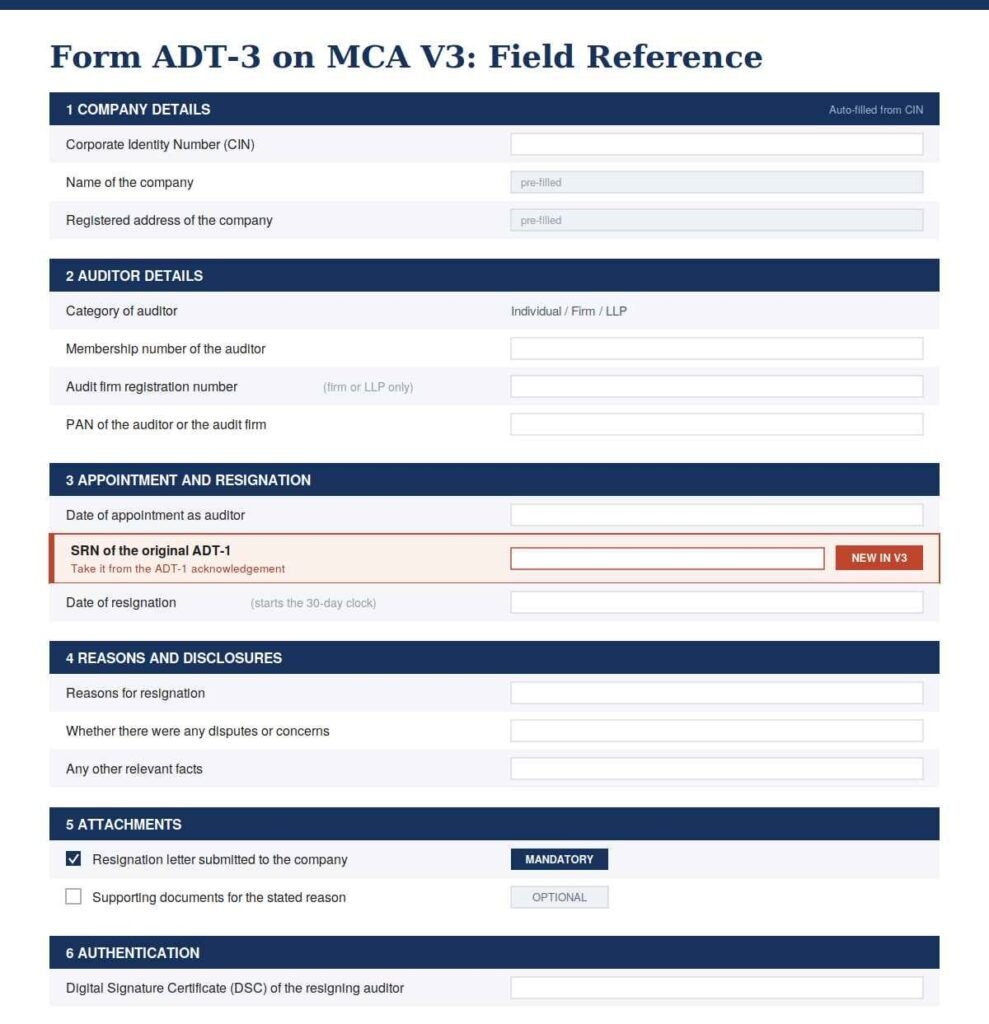
The one field that catches people out is the ADT-1 SRN. It did not exist on the old form. Pull it from the acknowledgement of the ADT-1 filed at the time of your appointment before you start, because the form will not let you submit without it.
Documents and Attachments Required for ADT-3
Only one attachment is mandatory. The rest are optional but sensible.
Mandatory: Resignation letter submitted to the company, with the company’s acknowledgement if you have it
Recommended:
- Any correspondence that supports the stated reason for resignation
- Board resolution recording the acceptance of the resignation
- Written communication with the audit committee, where one exists
Keep the reason in the form and the reason in the letter consistent. A mismatch between the two is the most common cause of a resubmission request from the Registrar.
Step-by-Step ADT-3 Filing Process on MCA V3
Here is the current process on the V3 portal:
Step 1: Prepare your resignation
Submit the resignation letter to the company and keep an acknowledged copy. You will attach it during filing.
Step 2: Log in as a Business User
Sign in to the MCA V3 portal as a Business User. A Registered User account cannot file or sign forms, so upgrade first if you are on one. Your Digital Signature Certificate (DSC) must also be associated with your profile and mapped to your role before you start.
Step 3: Open the ADT-3 web form
Go to MCA Services, then E-Filing, then Company Forms, and select Form ADT-3. The form opens in your browser as a web form.
Step 4: Enter the details
Enter the CIN and the portal pre-fills basic company data. Add the auditor category (individual, firm, or LLP), membership number, PAN, firm registration number where applicable, date of appointment, and date of resignation.
Step 5: Quote the ADT-1 SRN
The revised form now requires the Service Request Number (SRN) of the original ADT-1 through which you were appointed. This links your appointment to your resignation. Keep the SRN handy before you start.
Step 6: State the reason and attach documents
Write a clear, factual reason for resignation and attach the resignation letter along with any supporting documents. Avoid vague wording, since clear and factual reasons are always safer.
Step 7: Save, submit, and sign
You can save the form midway if you need to. On submission, affix your DSC to authenticate the filing.
Step 8: Pay and download the acknowledgement
Pay the filing fee, note the SRN the system generates, and download the acknowledgement. Track the status anytime under My Application.
Penalty for Not Filing ADT-3
Late filing or non-filing of ADT-3 attracts a penalty under Section 140(3) of the Companies Act, 2013. Here is how the amount works out.
- ₹50,000, or an amount equal to the auditor’s remuneration, whichever is lower
- A further ₹500 for each day the default continues, subject to a maximum of ₹2,00,000
Note that this is a penalty and not a criminal fine. The Companies (Amendment) Act, 2020 decriminalised Section 140(3) and reduced the continuing-default cap from ₹5,00,000 to ₹2,00,000. Several guides still carry the older figure, so check the date on anything quoting ₹5 lakh. Even so, the professional risk still matters. Regulators can treat persistent non-filing as negligence, and the Registrar can adjudicate the maximum penalty against auditors who ignore show-cause notices after missing the deadline.
ADT-1 vs ADT-2 vs ADT-3: Which Form Applies
The three ADT forms cover three different events and are filed by different parties. Mixing them up is the most common ADT filing error.
| Form | Event | Who Files | Deadline |
|---|---|---|---|
| ADT-1 | Appointment or reappointment of auditor | The company | 15 days from the AGM |
| ADT-2 | Removal of auditor before the end of term, under Section 140(1) | The company, to the Regional Director | 30 days from the Board resolution |
| ADT-3 | Resignation of auditor, under Section 140(2) | The resigning auditor | 30 days from resignation |
The short version: if the auditor chose to leave, it is ADT-3 and the auditor files it. If the company removed them, it is ADT-2 and the company files it, and it needs Central Government approval first.
ADT-4 is different again. It is filed by the auditor to report suspected fraud to the Central Government under Section 143(12), and has nothing to do with appointment or exit.
What the Company Must Do After an Auditor Resigns
Once the auditor files ADT-3, the company has its own duties:
- Create a casual vacancy
- Appoint a new auditor
- File ADT-1 for the new appointment
- Update records and ensure continuity in audit work
Both parties must coordinate to avoid compliance gaps.
Common Reasons for Auditor Resignation
Auditor resignations can occur due to various reasons, and filing Form ADT-3 provides an opportunity to formally document these causes. Some common reasons include:
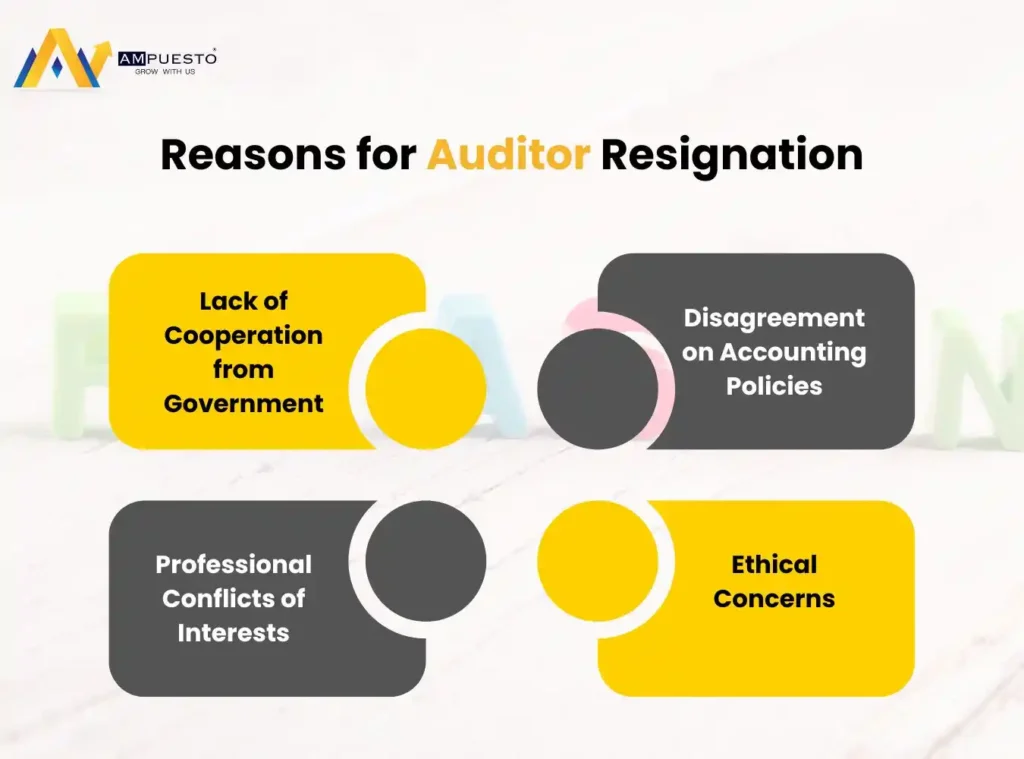
- Lack of Cooperation from Management: Instances where the company’s management or board does not provide sufficient support or access to financial records.
- Disagreements on Accounting Policies: Conflicts over the interpretation or application of accounting standards and policies.
- Professional Conflicts of Interest: Situations where the auditor’s independence or integrity may be compromised.
- Ethical Concerns: Concerns regarding ethical practices or adherence to regulatory requirements by the company.
Benefits of Timely Filing of ADT-3

1. Maintaining Transparency
Filing Form ADT-3 demonstrates the auditor’s commitment to transparency and accountability, reflecting positively on their professional conduct.
2. Legal Compliance
Timely filing ensures adherence to the Companies Act, 2013, protecting the auditor from penalties and legal complications.
3. Safeguarding Corporate Governance
By officially notifying the ROC, the filing of ADT-3 helps maintain robust corporate governance practices within the company.
Conclusion
ADT-3 isn’t just another compliance form. It’s a crucial document that ensures transparency when an auditor steps away from a company. Filing it on time, explaining the reasons clearly, and attaching the right documents keep both the auditor and the company safe from legal issues. When the process is followed properly, it maintains trust, clarity, and regulatory discipline – all of which are essential in corporate financial reporting.
Looking for expert guidance on corporate compliance and seamless filing processes? Trust AMpuesto to simplify your business needs today!
FAQs
Do all resignations need ADT-3?
Yes. Even if the resignation is for internal or personal reasons.
Can a company file ADT-3?
No. Only the auditor files it.
Does ADT-3 need a DSC?
Yes. Digital signature of the auditor is mandatory.
What if the auditor doesn’t file ADT-3?
They face penalties and professional repercussions.
Does ADT-3 apply to all companies?
Yes. Private, public, section 8, small, and listed companies are all covered under the Companies Act.
What is the ADT-3 filing fee?
₹200 to ₹600 for Indian companies, based on nominal share capital. Companies without share capital pay ₹200 and foreign companies pay ₹6,000. Filing late multiplies this by 2 to 12 times depending on the delay.
Can I download the ADT-3 form as a PDF?
No. ADT-3 became a web-based form on the MCA V3 portal on 14 July 2025. There is no downloadable template. You fill it in directly in your browser.
What happens if the auditor files ADT-3 after 30 days?
Two separate consequences. The portal charges an additional fee that multiplies the normal filing fee. Separately, the Registrar can adjudicate a penalty under Section 140(3) of ₹50,000 or the auditor’s remuneration, whichever is lower, plus ₹500 per day of continuing default up to ₹2,00,000.
Is Form GST ADT-03 the same as Form ADT-3?
No. They are unrelated. Form ADT-3 is an auditor resignation statement under the Companies Act, 2013. Form GST ADT-03 is a notice issued by a GST officer for conducting an audit under Section 65 of the CGST Act.
What is the difference between ADT-1 and ADT-3?
ADT-1 is filed by the company to report the appointment of an auditor. ADT-3 is filed by the auditor to report their own resignation. Different filer, different event, different deadline.
Do I need the ADT-1 SRN to file ADT-3?
Yes. The revised V3 form requires the Service Request Number of the ADT-1 through which you were originally appointed. Retrieve it from that filing’s acknowledgement before you start.
Does the auditor of an LLP file ADT-3?
No. ADT-3 is a Companies Act form. LLP audit arrangements fall under the LLP Act, 2008 and use a different process.