The Memorandum of Association (MoA) is the legal charter of a company. It defines the scope of activities a company can perform and establishes its relationship with shareholders, regulators, and external stakeholders.
If a company wants to change its business objectives, increase authorized share capital, shift its registered office, or change its name, it must amend the Memorandum of Association by following the procedure prescribed under Section 13 of the Companies Act, 2013.
This guide explains everything you need to know about MoA amendment in India, including: Clauses of Memorandum of Association, MoA amendment procedure, Section 13 alteration of MoA, ROC forms and approvals, MoA amendment fees, Compliance checklist and common mistakes.
What is Memorandum of Association (MoA)?
Under Section 2(56) of the Companies Act, 2013, the Memorandum of Association is the foundational legal document of a company.
It defines the limits within which a company can legally operate.
The MoA serves four major purposes:
- Defines the company’s business activities
- Limits the powers of the company
- Protects shareholders and creditors
- Provides transparency to regulators and investors
Once filed with the Registrar of Companies (ROC) during incorporation, the MoA becomes a public document accessible through the MCA portal.
Any activity outside the scope of the MoA is considered ultra vires, meaning beyond the powers of the company.
Clauses of Memorandum of Association
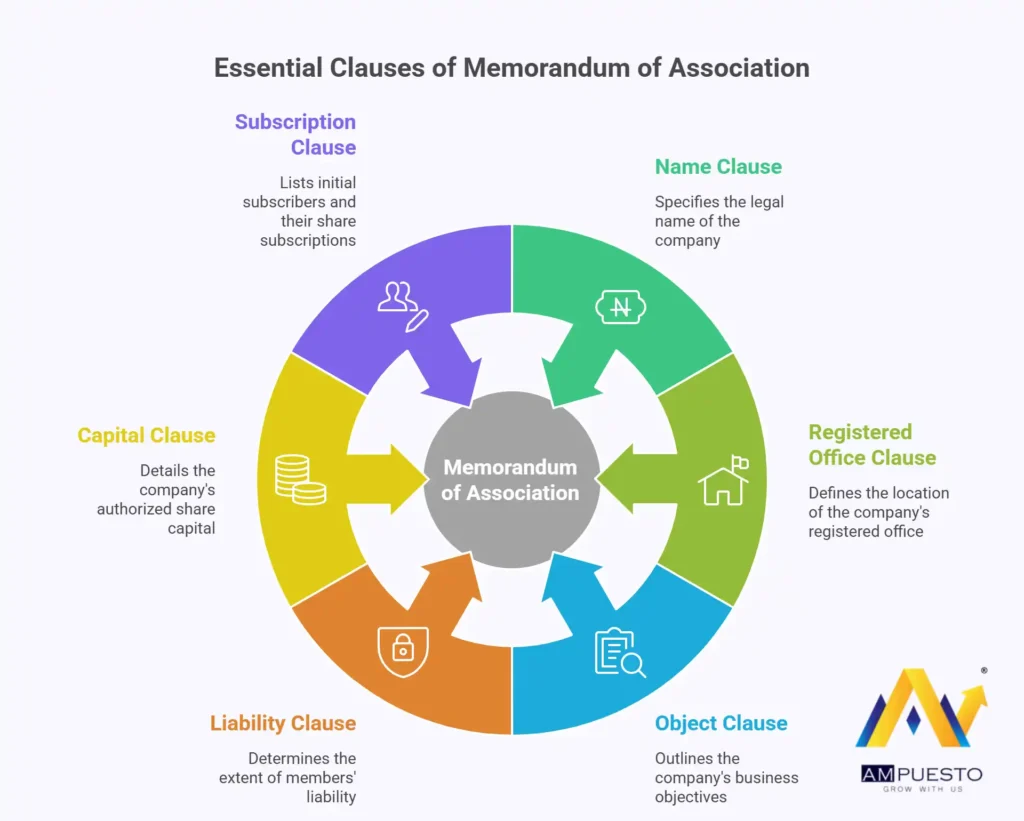
As per Section 4 of the Companies Act, 2013, the Memorandum of Association contains six essential clauses.
1. Name Clause
The Name Clause specifies the legal name of the company.
Naming rules include:
- Private companies must end with Private Limited
- Public companies must end with Limited
- One Person Companies must include OPC Private Limited
The company name must not be identical or similar to an existing company registered with the Ministry of Corporate Affairs.
Alteration of Name Clause
Changing the company name requires:
- Special Resolution by shareholders
- Central Government approval
- Filing forms with ROC
2. Registered Office Clause
This clause specifies the state in which the company’s registered office is located.
It determines:
- ROC jurisdiction
- Legal domicile of the company
- Applicable regulatory authority
Alteration of Registered Office
Procedure depends on relocation type:
(i). Within the same city: Board Resolution is sufficient.
(ii). Within the same state but different ROC jurisdiction: Special Resolution is required.
(iii). From one state to another: Special Resolution plus Central Government approval is required.
3. Object Clause
The Object Clause defines the purpose for which the company is established.
It includes:
- Main business objectives
- Activities incidental to the main business
A company cannot legally undertake activities outside its object clause.
Importance of Object Clause
- Protects shareholders from misuse of funds
- Protects creditors
- Ensures transparency
- Prevents unauthorized business activities
4. Liability Clause
The Liability Clause defines the liability of company members.
(i). Company Limited by Shares: Members are liable only for the unpaid value of shares.
(ii). Company Limited by Guarantee: Members contribute a predefined amount during winding up.
(iii). Unlimited Company: Members may have unlimited liability.
5. Capital Clause
This clause specifies:
- Authorized share capital
- Number of shares
- Face value of shares
If a company increases its authorized capital, it must alter the Capital Clause of the MoA.
6. Subscription Clause
The Subscription Clause contains:
- Names of initial subscribers
- Number of shares subscribed
- Signatures of subscribers and witnesses
This clause mainly applies during incorporation and generally remains unchanged afterward.
What is MoA Amendment?
A MoA amendment refers to the process of modifying the Memorandum of Association to reflect structural changes in the company.
Companies typically amend their MoA when they need to:
- Add new business activities
- Change company name
- Shift registered office to another state
- Increase authorized share capital
- Modify company structure
Without amending the MoA, performing activities outside its scope may be considered ultra vires and legally invalid.
Section 13 of Companies Act, 2013 – Alteration of MoA
Section 13 of the Companies Act, 2013 governs the alteration of Memorandum of Association.
This section allows companies to modify their MoA by following a defined legal procedure and obtaining shareholder approval.
Changes covered under Section 13 include:
- Change in company name
- Change in registered office between states
- Alteration of object clause
- Structural amendments to MoA
The primary requirement for most amendments is the passing of a Special Resolution by shareholders.
MoA Amendment Procedure (Step-by-Step)
Although the procedure may vary depending on the clause being altered, the general process includes the following steps.
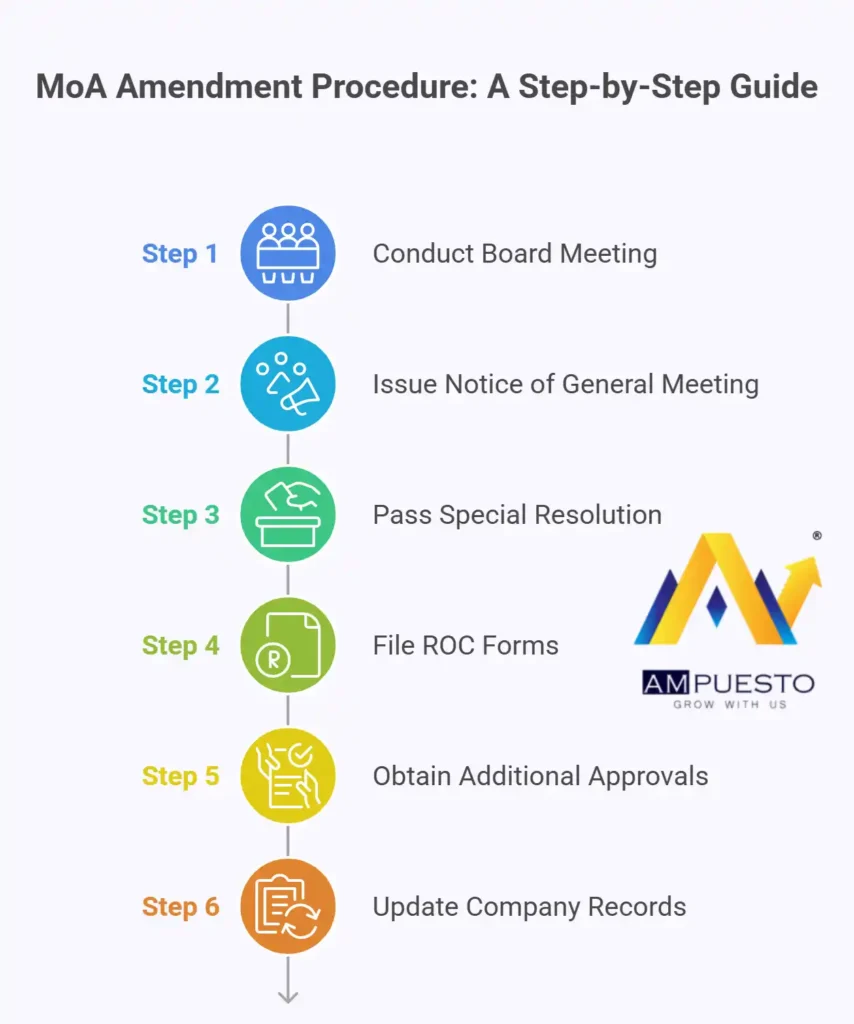
Step 1: Conduct Board Meeting
The company must hold a board meeting to:
- Approve the proposed amendment
- Approve draft amended MoA
- Fix date for General Meeting
- Approve notice to shareholders
Step 2: Issue Notice of General Meeting
A notice must be sent to shareholders at least 21 clear days before the meeting.
The notice must include:
- Agenda of the meeting
- Proposed amendment
- Explanatory statement under Section 102
Step 3: Pass Special Resolution
- During the General Meeting, shareholders vote on the amendment.
- A Special Resolution requires at least 75% approval.
- The resolution must be recorded in the minutes of the meeting.
Step 4: File ROC Forms
After passing the resolution, the company must file Form MGT-14 with the Registrar of Companies within 30 days.
Attachments typically include:
- Certified copy of Special Resolution
- Notice of General Meeting
- Altered MoA
- Explanatory statement
Step 5: Obtain Additional Approvals
Certain amendments require regulatory approval.
Examples include:
- Name change: Central Government approval
- Change of state: Regional Director approval
- Conversion of company type: additional regulatory approvals
Step 6: Update Company Records
After approval and registration with ROC:
- Update all copies of the MoA
- Update statutory registers
- Inform banks, regulators, and stakeholders
Documents Required for MoA Amendment
To complete the MoA amendment filing, you need to prepare and submit the following documents:
| Document | Details |
|---|---|
| Revised MoA | A clean copy of the MoA incorporating the proposed changes |
| Certified Copy of Special Resolution | Certified extract from the Minutes Book confirming the Special Resolution |
| Explanatory Statement | Statement explaining the reasons and implications of the proposed amendment (as required under Section 102) |
| EGM / AGM Notice | Formal notice of the General Meeting sent to all members |
| Form MGT-14 | Filed with the ROC within 30 days of the Special Resolution (for most MoA amendments) |
| Form SH-7 | Filed for increase in authorised share capital (within 30 days) |
| Form INC-24 | Filed for name change (for Central Government approval) |
| Board Resolution Copy | Certified extract of the Board Resolution approving the amendment |
| Form INC-23 | Application for change of registered office between states |
MoA Amendment Fees
The MoA amendment fees depend on the type of alteration and the company’s authorized share capital.
Estimated Cost
In most cases, companies spend approximately: ₹3,000 to ₹15,000, depending on the complexity of the amendment.
Typical cost components include:
1. ROC Filing Fees: Government fees vary based on authorized capital.
2. Professional Fees: Companies often engage CA or CS professionals for drafting and filing.
3. Form Filing Fees: Common filing forms include MGT-14, SH-7, and INC-24.
Late Filing Fees for MoA Amendment
If a company fails to file the required forms within the prescribed timeline, additional fees apply under Section 403 of the Companies Act, 2013.
| Period of Delay | Additional Fee |
|---|---|
| Up to 30 days beyond due date | 2x normal filing fee |
| 30 to 60 days | 4x normal filing fee |
| 60 to 90 days | 6x normal filing fee |
| 90 to 180 days | 10x normal filing fee |
| Beyond 180 days | 12x normal filing feee |
Late filing can significantly increase the cost of MoA amendment, so companies should ensure that ROC forms are submitted within the statutory deadlines.
Timeline for MoA Amendment
| Activity | Approximate Time |
|---|---|
| Board Meeting & drafting notice | 1–2 days |
| Notice period before General Meeting | 21 clear days |
| General Meeting & passing resolution | 1 day |
| ROC filing (MGT-14) | Within 30 days of resolution |
| ROC processing & approval | 7–15 working days (routine cases) |
| Name change or state shift (with Central Govt. approval) | 60–90 days (additional) |
Doctrine of Ultra Vires
The Doctrine of Ultra Vires is a key principle of company law.
If a company performs activities outside the scope of its MoA:
- The act becomes legally void
- Shareholders cannot ratify the act
- Directors may face personal liability
This doctrine ensures companies operate strictly within their authorized objectives.
Common Mistakes to Avoid in MoA Amendment
Companies often face compliance issues due to the following errors:
- Not passing Special Resolution
- Missing the 30-day ROC filing deadline
- Drafting vague or restrictive object clauses
- Not checking Articles of Association
- Ignoring postal ballot requirements for public companies
- Failing to update statutory records
Practical Example: How ABC Private Limited Amended Its MoA
Consider ABC Private Limited, which was incorporated solely to carry out electronic goods trading. After three years of operations, the company decided to launch a software development division.
However, since the object clause mentioned only electronics trading, starting a software business would be an ultra vires act.
Therefore, ABC Private Limited followed this process:
1. The Board of Directors held a meeting and passed a Board Resolution approving the proposed addition to the object clause.
2. The company sent a 21-day notice of an Extraordinary General Meeting (EGM) to all shareholders, along with an Explanatory Statement.
3. At the EGM, the shareholders passed a Special Resolution with 80% votes in favour, amending the object clause to include software development, IT services, and related activities.
4. Within 30 days of the EGM, the company filed Form MGT-14 with the ROC along with the certified resolution, EGM notice, and the amended MoA.
5. The ROC processed and registered the alteration within 10 working days.
Only after receiving confirmation from the ROC did ABC Private Limited begin its software operations – fully compliant and legally protected.
Compliance Checklist for Professionals
Before initiating a MoA amendment, professionals should verify:
- Review existing MoA
- Draft the amended clause clearly
- Ensure consistency with Articles of Association
- Identify required regulatory approvals
- File ROC forms within the deadline
- Maintain updated statutory records
Conclusion
Amending the Memorandum of Association is an important corporate compliance process that ensures a company’s legal charter reflects its evolving business objectives.
Section 13 of the Companies Act, 2013 provides a structured framework for altering the MoA through shareholder approval and regulatory filing.
By following the correct procedure, filing ROC forms on time, and updating company records, businesses can expand their operations while remaining fully compliant with corporate law.
FAQs
MoA amendment refers to the legal process of modifying the Memorandum of Association to change the company’s name, object clause, registered office, or capital structure.
The process generally includes board approval, notice of general meeting, passing Special Resolution, filing Form MGT-14 with ROC, and obtaining regulatory approvals if required.
MoA amendment fees vary depending on the type of change and authorized share capital. Typically, the cost ranges between ₹3,000 and ₹15,000.
The primary form used is MGT-14, filed after passing the Special Resolution. Other forms such as SH-7 and INC-24 may also apply depending on the amendment.
Yes. A company can change its object clause by passing a Special Resolution and filing the amendment with the Registrar of Companies under Section 13 of the Companies Act, 2013.
ROC approval is required for certain amendments such as company name change or registered office transfer between states.