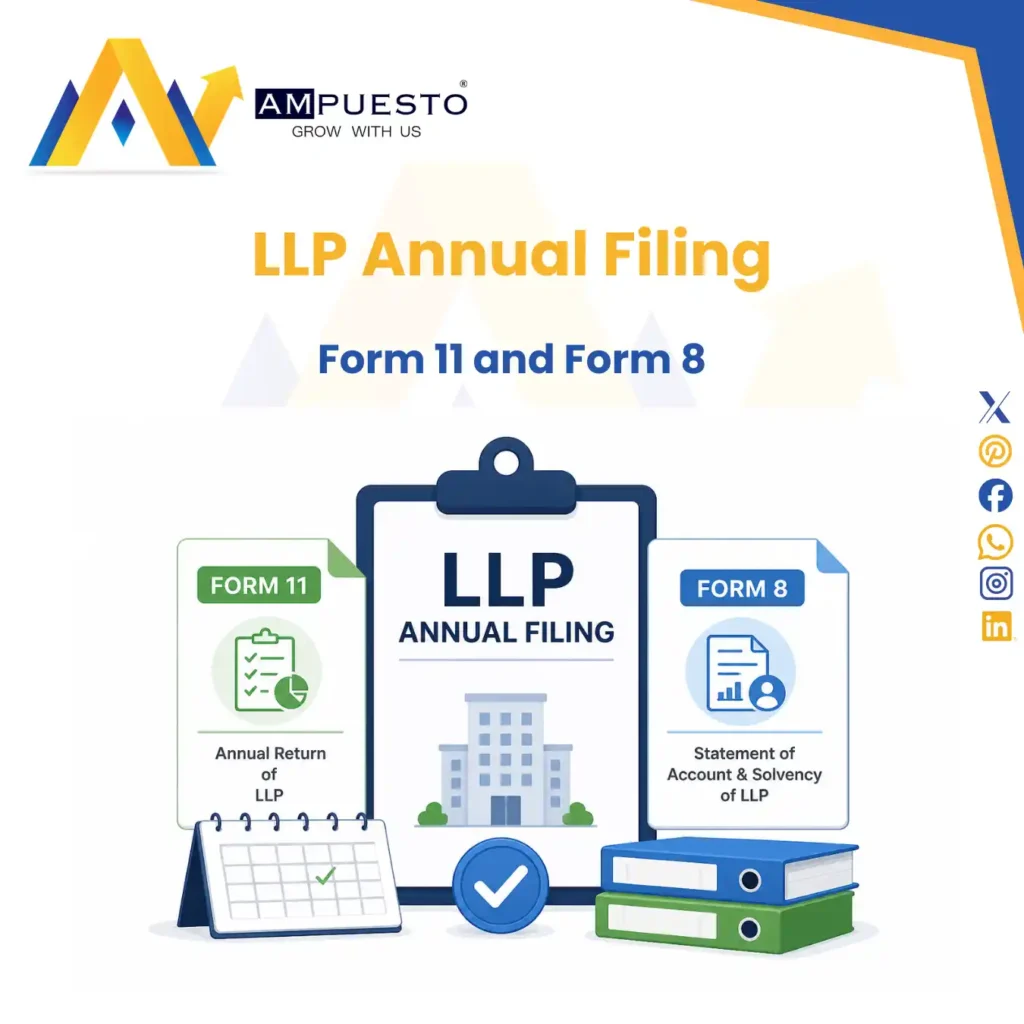
Every Limited Liability Partnership registered under the LLP Act, 2008 must complete two key annual filings with the Ministry of Corporate Affairs. These are Form 11 (Annual Return) and Form 8 (Statement of Accounts and Solvency).
Here’s the thing. Even if your LLP has zero transactions, you still need to file both. Missing deadlines leads to a ₹100 per day penalty with no upper limit. Over time, non-compliance can even lead to strike-off.
This guide breaks everything down clearly so you can file correctly, avoid penalties, and stay compliant.
Form 11 vs Form 8: Key Differences
Let’s quickly understand how these two forms differ:
| Particulars | Form 11 | Form 8 |
|---|---|---|
| Full Name | Annual Return | Statement of Account & Solvency |
| Filed With | ROC / MCA Portal | ROC / MCA Portal |
| Due Date | 30 May every year | 30 October every year |
| Applicable To | All LLPs (including dormant) | All LLPs with transactions |
| Audit Required? | No (CS cert. if contribution >₹50L or turnover >₹5Cr) | Yes, if turnover >₹40L or contribution >₹25L |
| Signatories | 1 Designated Partner (DSC) | 2 Designated Partners + CA/CS/CMA if audited |
| Late Penalty | ₹100/day (no cap) | ₹100/day (no cap) |
This comparison gives you a quick snapshot. Now let’s go deeper.
What is Form 11 (Annual Return)?
Form 11 is a structural return filed under Section 35(1) of the LLP Act. It captures ownership and management details of your LLP as of 31 March.
In simple terms, it tells the government who runs your LLP and how it is structured.
Who Must File Form 11?
Every LLP must file Form 11. This includes:
- Active LLPs
- Dormant LLPs
- LLPs with no income or transactions
However, if your LLP was incorporated after 1 October, you may skip the first filing and submit it the following year.
Information Required in Form 11
You need to provide:
- LLP name, address, and LLPIN
- Total number of partners and designated partners
- Contribution details from all partners
- Changes in partners during the year
- Details of partners involved in other companies or LLPs
- Penalties or compounding offences, if any
Documents Required for Form 11
- LLPIN (auto-filled from MCA portal)
- DSC of one designated partner
- Details of partner associations in other entities
- CS certificate if:
- Contribution exceeds ₹50 lakh, or
- Turnover exceeds ₹5 crore
- SRN of Form 4 if partner changes occurred
What is Form 8 (Statement of Accounts & Solvency)?
Form 8 focuses on financial health. It is filed under Section 34 of the LLP Act and includes a solvency declaration.
What this really means is you are confirming that your LLP can pay its debts and is financially stable.
What Does Form 8 Include?
Form 8 contains:
- Statement of Solvency
- Balance Sheet (Assets and Liabilities)
- Income and Expenditure Statement
- MSME disclosures
Documents Required for Form 8
- Balance Sheet as of 31 March
- Income and Expenditure Statement
- MSME disclosures
- DSC of two designated partners
- Audit report (if applicable)
Audit Requirement for Form 8
Let’s break it down simply:
No Audit Required
- Turnover up to ₹40 lakh
- AND contribution up to ₹25 lakh
In this case, designated partners can sign directly
Audit Mandatory
- Turnover exceeds ₹40 lakh
- OR contribution exceeds ₹25 lakh
In such cases, Form 8 must be certified by a practising CA, CS, or CMA
Due Dates You Must Remember
- Form 11 Due Date: 30 May every year (within 60 days of the end of the financial year)
- Form 8 Due Date: 30 October every year (within 30 days from the end of 6 months of the financial year)
Missing these dates leads to daily penalties, so it’s smart to prepare early.
Consequences of Late Filing
Ignoring compliance can cost you more than just penalties.
Here’s what can happen:
- ₹100 per day penalty with no cap
- DPIN deactivation of designated partners
- Restrictions on MCA filings
- LLP strike-off by ROC
- Difficulty in loans and tenders
So yes, filing on time is not optional. It is critical.
Conclusion
Form 11 and Form 8 are the backbone of LLP compliance in India. One defines your structure, the other confirms your financial health. Together, they keep your LLP legally active and credible.
Mark your calendar for 30 May and 30 October. Prepare early, verify your data, and avoid last-minute stress. If things feel complex, it is always better to consult a professional.
Because in compliance, delays are expensive, but accuracy pays off.
FAQs
Form 11 focuses on partner details and structure. Form 8 focuses on financial statements and solvency.
Yes. Even if your LLP has no business activity, you must file both forms.
No. Form 11 must be filed first. The system will not allow Form 8 otherwise.
No. Once submitted, these forms cannot be revised. Accuracy is crucial.
You face daily penalties, possible disqualification of partners, and even strike-off.
No. Audit is required only if turnover exceeds ₹40 lakh or contribution exceeds ₹25 lakh.