Introduction
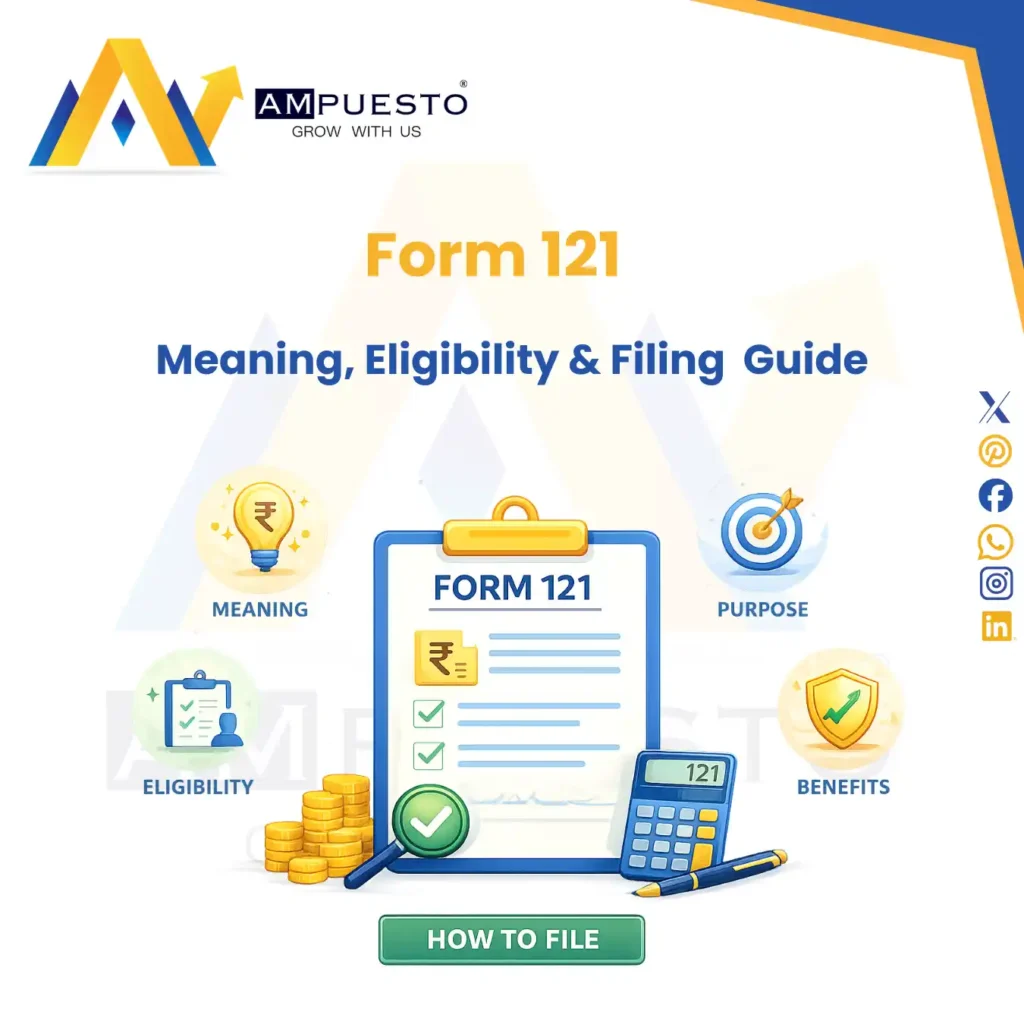
From April 1, 2026, a major change has simplified TDS compliance in India. The government has introduced Form 121, replacing both Form 15G and Form 15H with a single unified declaration.
If you earn interest income or similar earnings and your total tax liability is zero, this form directly affects you. Instead of dealing with multiple forms and confusion around age-based eligibility, you now have one simple solution.
So, what this really means is less paperwork, fewer errors, and better control over your income without unnecessary TDS deductions.
Quick Summary
- What it is: A self-declaration to prevent TDS when your annual tax liability is nil
- Replaces: Form 15G and Form 15H, with no age restriction
- Effective from: 1 April 2026 Legal basis: Section 393(6), Income Tax Act 2025, read with Rule 211
- Who can file: Resident individuals and HUFs with income below the basic exemption limit
- Submit to: Banks, NBFCs, post office, EPFO, separately to each
- Mode: Fully digital, with one UIN per PAN per year
What is Form 121 in Income Tax?
Form 121 is a self-declaration form governed by Section 393(6) of the Income Tax Act, 2025, read with Rule 211 of the Income Tax Rules, 2026. You submit this form to a bank, financial institution, or EPFO to request them to stop deducting TDS on your eligible income.
In simple terms, you declare to the payer that your estimated total income for the tax year stays below the taxable limit and that your final tax liability is nil. Based on that declaration, the payer stops deducting TDS from your income.
Earlier, taxpayers below 60 years used Form 15G, and senior citizens used Form 15H. Now, Form 121 replaces both. So, regardless of your age, you use the same form and follow one unified process.
Basic Exemption Limits for Form 121 Eligibility
Here are the applicable limits for Tax Year 2026-27:
| Taxpayer Category | Basic Exemption Limit |
|---|---|
| General individuals (below 60 years) | Rs. 2,50,000 |
| Senior citizens (60 to 79 years) | Rs. 3,00,000 |
| Super senior citizens (80 years and above) | Rs. 5,00,000 |
| New tax regime (all ages) | Rs. 3,00,000 |
| Hindu Undivided Family (HUF) | Rs. 2,50,000 |
If your estimated total income for the financial year stays below the applicable limit above, and your tax liability is nil, you can file Form 121.
Quick example: You are 45 years old. Your only income is Rs. 2,20,000 in fixed deposit interest. That amount is below the Rs. 2,50,000 limit for your age group. Therefore, you qualify to submit Form 121 and prevent TDS on your FD interest.
However, if your salary is Rs. 3,00,000 and you also earn Rs. 80,000 in FD interest, your total income becomes Rs. 3,80,000. In that case, your income crosses the exemption limit, so you should not file this form.
Eligibility Criteria for Form 121
Beyond the exemption limit, you must meet all of the following conditions to file Form 121 correctly:
- You are a resident individual or an HUF
- Your estimated total income falls below the applicable basic exemption limit
- Your total tax liability for the year is nil
- You hold a valid PAN
- You correctly disclose all your income sources in the declaration
Note that NRIs, companies, and firms cannot file this form. If you are unsure about any income source, do not submit the form. An incorrect filing can lead to penalties and tax notices. As a quick cross-check, your declared income should reconcile with what already shows up in your records, and it helps to understand the difference between AIS and TIS before you file.
Not sure you qualify? Download our free Form 121 eligibility checklist and tick off each condition before you file. It takes two minutes and helps you avoid a wrongful declaration.
Who Should NOT File Form 121
Just as important as knowing who qualifies is knowing who does not. You should skip Form 121 if:
- Your total income exceeds the basic exemption limit
- You have taxable capital gains from shares or property
- You are a Non-Resident Indian
- Your employer already deducts TDS from your substantial salary
- You are unsure whether your total income stays within the limit
- You are a company or a partnership firm
Because this is a legal declaration, filing it when you do not qualify carries serious consequences, which we cover later in this guide.
Realised you do not qualify, or you are the one deducting TDS? A wrong declaration invites a notice, and the safer route is to file correctly. We handle end-to-end TDS and TCS return filing so nothing slips past a due date.
Types of Income Covered Under Form 121
Form 121 applies to more income types than most people expect. You can use it for any of the following:
- Fixed deposit interest
- Savings account interest
- Recurring deposit interest
- Post office deposit interest
- Dividend income from shares or mutual funds
- Income from units of mutual funds
- Payments under life insurance policies
- EPF or PF withdrawals under qualifying conditions
- Rent income under certain notified conditions
- Interest on securities in some cases
Importantly, salary income is not covered. Also, if you have taxable capital gains, you cannot file Form 121 even if all other conditions are satisfied.
Structure of Form 121: Part A and Part B
Form 121 has two main parts. Each part serves a different purpose, and understanding both helps you fill the form correctly without errors.
Part A: Filled by the Taxpayer (Declarant)
Part A is the section you fill out. It captures your personal information, your income details, and your declaration. Here is what each key field means:
| Field | What It Means |
|---|---|
| Name | Your full legal name as it appears on your PAN card |
| Address | Your current residential address, including pin code |
| PAN | Your Permanent Account Number |
| Status | Whether you are an Individual or an HUF (see below) |
| Residential Status | Confirm that you are a Resident of India |
| Date of Birth | Your date of birth, or date of incorporation if you are an HUF |
| Tax Year | The financial year for which you are filing (for example, 2026-27) |
| Nature of Income | The type of income for which you want to prevent TDS (for example, FD interest) |
| Estimated Income (Row 10) | The estimated amount of that specific income during the year |
| Row 11: Previous Declarations | Details of any other Form 121 you already submitted to other banks in the same year |
| Row 12: Aggregate Income | Total of all income covered under all your Form 121 submissions combined |
| Row 13: Total Estimated Income | Your complete estimated income for the year from every source, including all Form 121 submissions |
| Row 14: Return Income (Last 2 Years) | The total income you declared in your ITR for the previous two tax years, along with acknowledgment numbers |
Part B: Filled by the Payer or Deductor
Part B is the section that your bank or institution fills. After receiving your Part A declaration, the payer records your details, verifies your PAN, and assigns a Unique Identification Number called a UIN to your declaration. The payer then uses this UIN in their quarterly TDS filings.
Form 121 for EPF Withdrawals: EPFO Guide
EPFO adopted Form 121 as the official replacement for Form 15G for PF withdrawals. This matters because TDS applies on EPF withdrawals when you withdraw before completing five years of continuous service and the withdrawal amount exceeds a set threshold.
You can submit Form 121 to EPFO if:
- You are making a withdrawal from your EPF account
- Your total income for the year, including the withdrawal amount, stays below the basic exemption limit
- Your final tax liability is nil
Example: You withdraw Rs. 48,000 from your EPF account. Your total income for the year, including the withdrawal, is Rs. 2,30,000. Since this is below the Rs. 2,50,000 limit, you can submit Form 121 to EPFO to prevent TDS on the withdrawal.
To submit Form 121 to EPFO, log in to the EPFO Unified Member Portal. Navigate to the withdrawal section, select the relevant claim type, and submit your Form 121 declaration before finalising the withdrawal claim.
When to Submit Form 121
Timing matters more than most people realize.
You should ideally submit Form 121:
- At the beginning of the financial year
- Before interest or income is credited
- As early as possible to avoid TDS deduction
If you delay submission, TDS may already be deducted. In that case, you will need to claim a refund while filing your ITR.
Where to Submit Form 121
You must submit Form 121 to each institution separately, such as:
- Banks
- NBFCs
- Post office
- EPFO or other institutions
Submitting it to one bank does not automatically apply to others.
Step-by-Step Process to File Form 121 Online
Most banks now support online submission, which makes the process faster and paperless. Here is the general step-by-step flow:
- Log in to your bank’s internet banking portal or mobile app
- Go to the Service Requests or Taxes section
- Select TDS Declaration or Form 121
- Enter your PAN, date of birth, and contact details
- Select the nature of income, such as FD interest or savings interest
- Enter your estimated income amount for that income type
- Declare your estimated total income from all sources for the year
- Enter your ITR acknowledgment number and return income for the last two years, if available
- Confirm the declaration and submit
After submission, the bank processes your form and stops deducting TDS on the declared income. You typically receive a confirmation message or email within a few working days.
Documents You Need to File Form 121
You do not need many documents, but having these ready makes the filing process smooth:
- PAN card
- Estimated income calculation (across all banks and sources)
- ITR acknowledgment numbers for the last two tax years
- Bank account details
- Date of birth proof (required for physical submissions at some institutions)
Comparison: Form 121 vs Form 15G vs Form 15H
| Feature | Form 15G | Form 15H | Form 121 |
|---|---|---|---|
| Valid from | Before April 1, 2026 | Before April 1, 2026 | April 1, 2026 onwards |
| Age restriction | Only below 60 years | Only 60 years and above | No age restriction |
| Legal basis | Section 197A, IT Act 1961 | Section 197A, IT Act 1961 | Section 393(6), IT Act 2025 |
| UIN system | Multiple UINs per payer | Multiple UINs per payer | Single UIN per PAN per year |
| Digital submission | Partially digital | Partially digital | Fully digital |
| Number of forms | Different forms for different ages | Different forms for different ages | One form for everyone |
What Happens If You Do Not Submit Form 121
If you choose not to submit the form:
- TDS will be deducted as per the rules
- You can claim a refund while filing your income tax return
So, the form is optional, but it helps you avoid unnecessary deductions upfront.
Conclusion
Form 121 is one of the most practical simplifications that came with the new Income Tax Act, 2025. It removes the age-based confusion of the old system and gives every eligible taxpayer a single, clear route to avoid unnecessary TDS deductions.
FAQs
1. Is Form 121 mandatory?
No, it is optional. However, if you do not submit it, TDS will be deducted, and you will need to claim a refund later.
2. Can senior citizens use Form 121?
Yes, senior citizens can use it. It replaces Form 15H, so age-based forms are no longer required.
3. Can I submit Form 121 offline?
Yes, some institutions may allow offline submission, although online submission is more common.
4. Do I need to submit Form 121 every year?
Yes, you need to submit it at the beginning of each financial year.
5. What happens if I submit Form 121 incorrectly?
Incorrect declarations can lead to penalties and tax notices, so you should ensure all details are accurate.
6. Can I submit Form 121 to multiple banks?
Yes, you must submit it separately to each bank or institution where you earn income.
7. What is UIN in Form 121?
UIN stands for Unique Identification Number. The payer assigns one UIN per PAN per tax year.