
Introduction
Starting a business is exciting, but choosing the right structure matters just as much as your idea. In India, many founders prefer a private limited company because it offers credibility, limited liability, and better growth potential.
However, the real confusion begins with the registration process. Many people think it is complex or time-consuming. In reality, if you follow the right steps, the process is straightforward and structured.
In this guide, you will learn the exact step-by-step process to register a private limited company in India, along with key requirements and practical tips to avoid delays.
Quick Overview of Private Limited Company Registration
Before we go deeper, here is a quick snapshot:
- Minimum directors required: 2
- Minimum shareholders: 2
- Maximum shareholders: 200
- Registration authority: MCA (Ministry of Corporate Affairs)
- Time required: 7 to 15 working days
Step-by-Step Process to Register a Private Limited Company in India
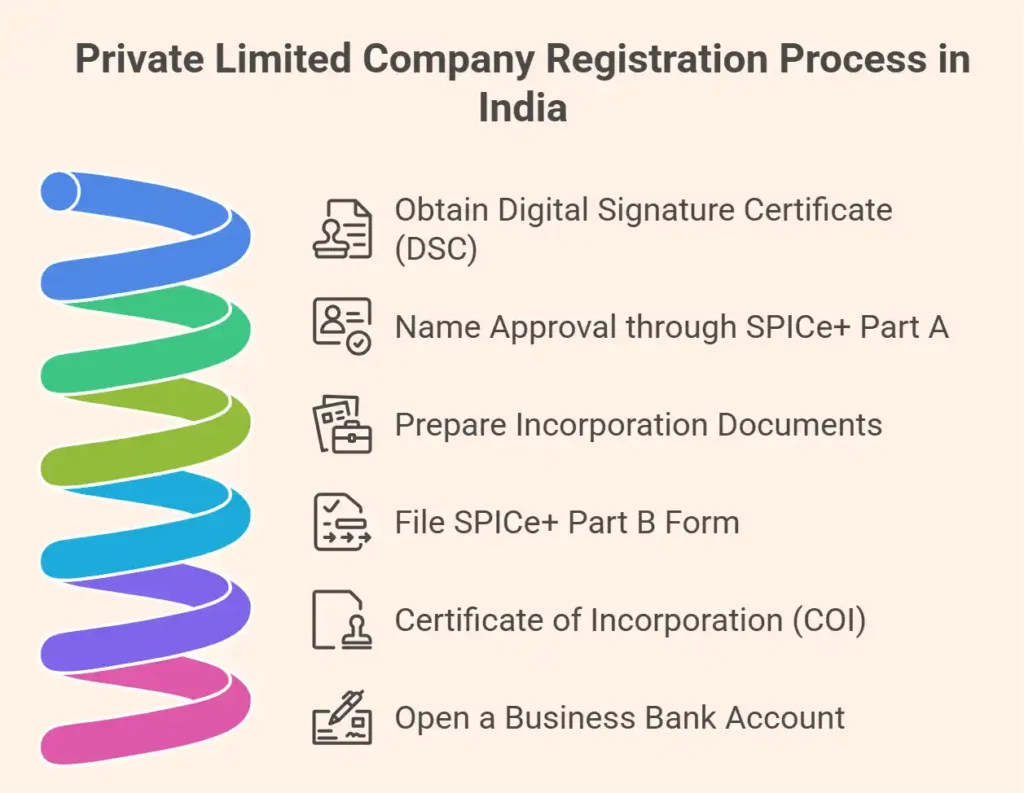
Let’s break it down clearly.
1. Obtain Digital Signature Certificate (DSC)
First, all proposed directors must get a Digital Signature Certificate.
Since company registration is completely online, DSC is required to sign documents electronically. Without this, you cannot proceed further.
2. Name Approval through SPICe+ Part A
Now comes an important step. You need to choose a unique company name.
You must apply through the SPICe+ form on the MCA portal. Make sure:
- The name is unique
- It does not match existing companies
- It follows MCA naming guidelines
A strong and relevant name increases approval chances.
3. Prepare Incorporation Documents
Once your name gets approved, you need to prepare the required documents.
This includes:
- Memorandum of Association (MOA)
- Articles of Association (AOA)
- Address proof
- Identity proof of directors
Accuracy is critical here because small mistakes can lead to rejection.
4. File SPICe+ Part B Form
After document preparation, you must file the SPICe+ Part B form.
This is the main incorporation form where you submit:
- Company details
- Director details
- Registered office address
During this process, Director Identification Number (DIN) is allotted to proposed directors.
At this stage, you can also apply for:
- PAN
- TAN
5. Certificate of Incorporation (COI)
Once the application is verified and approved, MCA issues the Certificate of Incorporation.
This certificate confirms that your company is legally registered.
It also includes:
- Company CIN number
- Date of incorporation
6. Open a Business Bank Account
After receiving the certificate, you should open a company bank account.
This allows you to:
- Manage finances properly
- Receive payments
- Maintain compliance
Time Required for Registration
In most cases, the registration process takes between 7 to 15 working days.
However, delays may happen if:
- Documents are incorrect
- Name approval gets rejected
- MCA raises queries
So, accuracy at each step matters.
Cost of Private Limited Company Registration
The cost depends on multiple factors such as:
- Government fees
- Professional fees
- Number of directors
On average, it may range between ₹7,000 to ₹25,000.
For a detailed breakdown, you can check our guide on cost of private limited company registration.
Common Mistakes to Avoid
Many applications get delayed due to simple mistakes. Here are a few you should avoid:
- Choosing a similar or restricted name
- Uploading incorrect documents
- Mismatch in details across documents
- Ignoring compliance requirements
Fixing these early can save both time and effort.
Why Choose a Private Limited Company?
A private limited company offers several advantages:
- Limited liability protection
- Separate legal identity
- Easy access to funding
- Better brand credibility
That is why startups and growing businesses prefer this structure.
Need Help with Registration?
While the process looks simple, execution requires accuracy and compliance.
If you want a smooth and hassle-free experience, you can explore our private limited company registration services in India
Conclusion
Registering a private limited company in India is not as complicated as it seems. Once you understand the process, you can move step by step with clarity.
More importantly, getting the foundation right helps you avoid legal and compliance issues later. So, take your time, prepare your documents carefully, and follow the correct process.
FAQs
1. How many days does it take to register a private limited company in India?
Usually, it takes around 7 to 15 working days, depending on approvals and document accuracy.
2. Can I register a private limited company alone?
No, you need at least two directors and two shareholders to register a private limited company.
3. Is GST registration mandatory after company registration?
Not always. GST is required only if your business crosses the threshold or falls under mandatory categories.
4. What is the minimum capital required?
There is no minimum capital requirement. You can start with any reasonable amount.
5. Can a salaried person start a private limited company?
Yes, a salaried person can become a director in a company, provided employment terms allow it.